Key takeaways
- Identify your boat's specific lag time from a hover to full speed in different wind conditions.
- Use the final 10 seconds to bear away slightly and build flow over the foils before heading up to close-hauled.
- Account for sea state; waves require an earlier trigger pull to overcome inertia.
- Always maintain steerage during the setup to ensure you can defend your space and respond to Rule 11 obligations.
The Lost Art of the Trigger Pull
Every Tuesday night on Lake Mendota, I see the same scene: ten boats lined up perfectly on the starting line, but half of them are sitting dead in the water. They timed their approach to the line perfectly, but they forgot one crucial element—acceleration. In sailboat racing, being on the line at zero knots is often worse than being a boat length behind at full speed.
Acceleration is what we call the 'trigger pull.' It is the deliberate transition from a slow, hovering position to a full-power sprint. Understanding your boat’s specific time-on-distance requirements is the difference between leading the fleet into the first cross or spending the entire upwind leg fighting for clear air.
Understanding Your Boat's Lag Time
Every boat has a different 'spin-up' time. If you are racing a heavy cruiser-racer on Lake Michigan, like a Tartan 10 or a J/105, your inertia is high. Once you stop, it takes a significant amount of time and a wide angle to the wind to get the water flowing over the keel and rudders again. Conversely, if you are in a Melges 15 on an inland lake, you can accelerate almost instantly.
To master your start, you need to know exactly how many seconds it takes for your boat to go from a 'hover' (sails luffing, just enough steerage to stay head-to-wind) to full target speed. In a moderate 10-knot breeze, a mid-sized keelboat might need 6 to 8 seconds to get moving. If you pull the trigger at 5 seconds, you’ll be late. If you pull it at 10, you’ll be over early.
The Time-on-Distance Calculation
Time-on-distance is the mental (or electronic) calculation of how long it will take you to cover the remaining gap to the line at your current or projected speed.
I like to use a 'pacing' method. During your pre-race warm-up, pick a buoy and practice approaching it at a slow speed, then 'pull the trigger' at a set distance. Count out loud. Did it take you four boat lengths to hit full speed? Five?
On the starting line, I mentally divide the final approach into thirds:
- The Setup (30-45 seconds to go): Get into your hole, maintain steerage, and defend your gap to leeward.
- The Build (15-20 seconds to go): Start trimming in slightly to create a small flow over the foils. You aren't at full speed yet, but you aren't stalled.
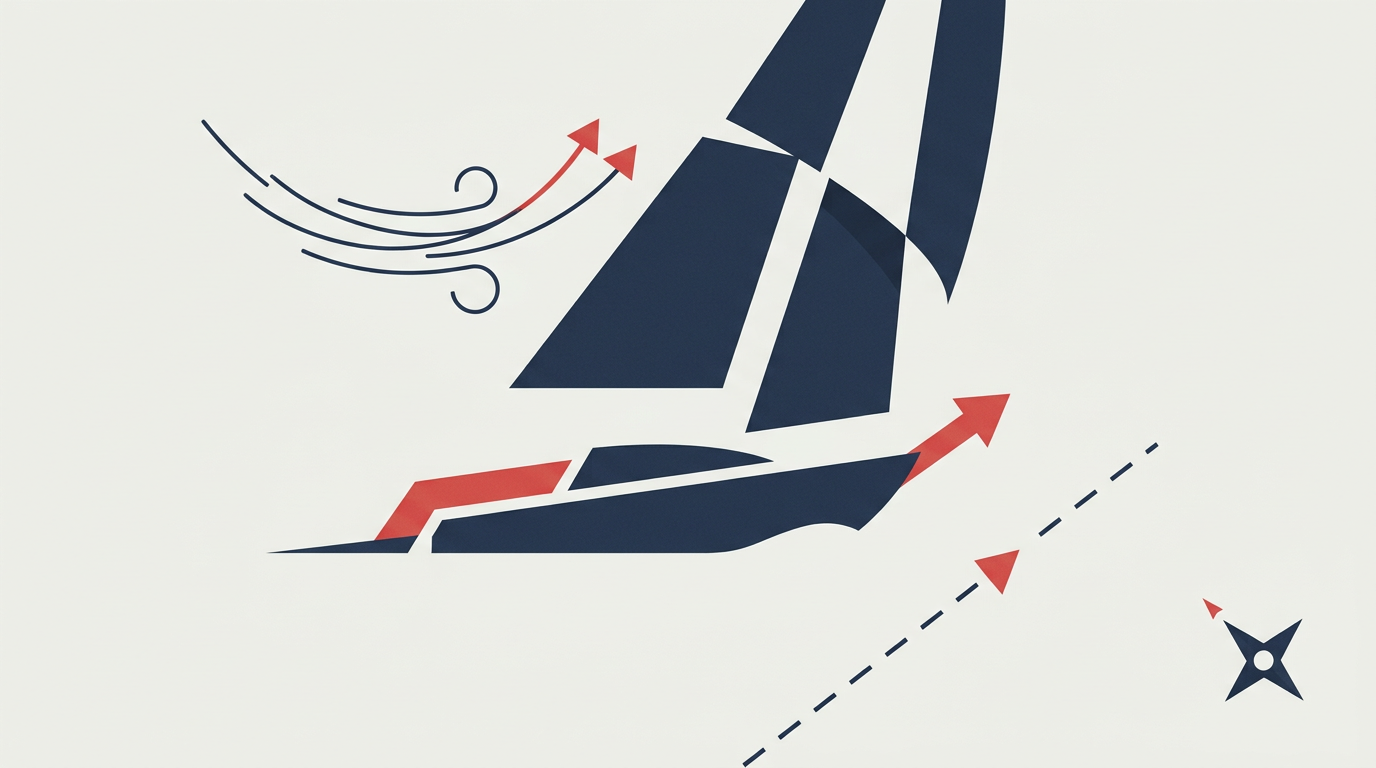
- The Trigger (6-10 seconds to go, depending on boat): Sheet in hard, hike out, and bear away slightly to a close-reach to get the flow attached to the keel before heading up to a close-hauled course.
A Real-World Example: Lake Michigan Chop
I remember a regatta off Milwaukee where the wind was a steady 15 knots, but the Lake Michigan chop was significant. Several boats tried to time their starts as if they were on a flat inland lake. They waited until 5 seconds to sheet in. Because of the waves, their bows were knocked leeward, and the boats lacked the power to punch through the sea state from a standstill.
My crew and I decided to pull the trigger early—at 12 seconds. We gave ourselves extra room to leeward, bore away to gain momentum, and hit the line at full speed while the boats around us were still wallowing in the waves. We surged ahead by half a boat length within the first thirty seconds simply because of that initial momentum.
Safety and the Racing Rules
When you are working on your acceleration, you must remain mindful of Rule 11 (On the Same Tack, Overlapped) and Rule 16.1 (Changing Course). As you bear away to accelerate, you are the windward boat if you are above someone, and you must keep clear. Furthermore, if you are the right-of-way boat and you change course to accelerate, you must give the other boat room to keep clear.
Practical Tips for Your Next Race
- Watch the Bow: If your bow is swinging wildly, you don't have steerage. You need to keep a tiny bit of tension on the sails even while waiting.
- Clear the Sheets: Ensure your jib sheets aren't snagged. A bungled acceleration often happens because a winch handle is in the way or a line is knotted.
- Communicate: The helm should count down the 'trigger pull' so the crew is ready to hike and trim simultaneously. Coordination is key to converting that wind energy into forward motion rather than just heel.
Written by Dmitry Shteyn — Wisconsin sailor and educator. Find more sailing notes on the daily blog or read the longer guides.