Key takeaways
- Prioritize flow over height; a stalled boat has no tactical options in a crowd.
- Establish inside overlaps before the three-length zone to secure your right to mark-room under Rule 18.2.
- Use subtle weight shifts and sail trim to turn the boat, preserving momentum for the downwind transition.
- Anticipate the exit; sometimes a slightly wide rounding provides the clear air needed to accelerate away from the pack.
The Chaos of the Top Mark
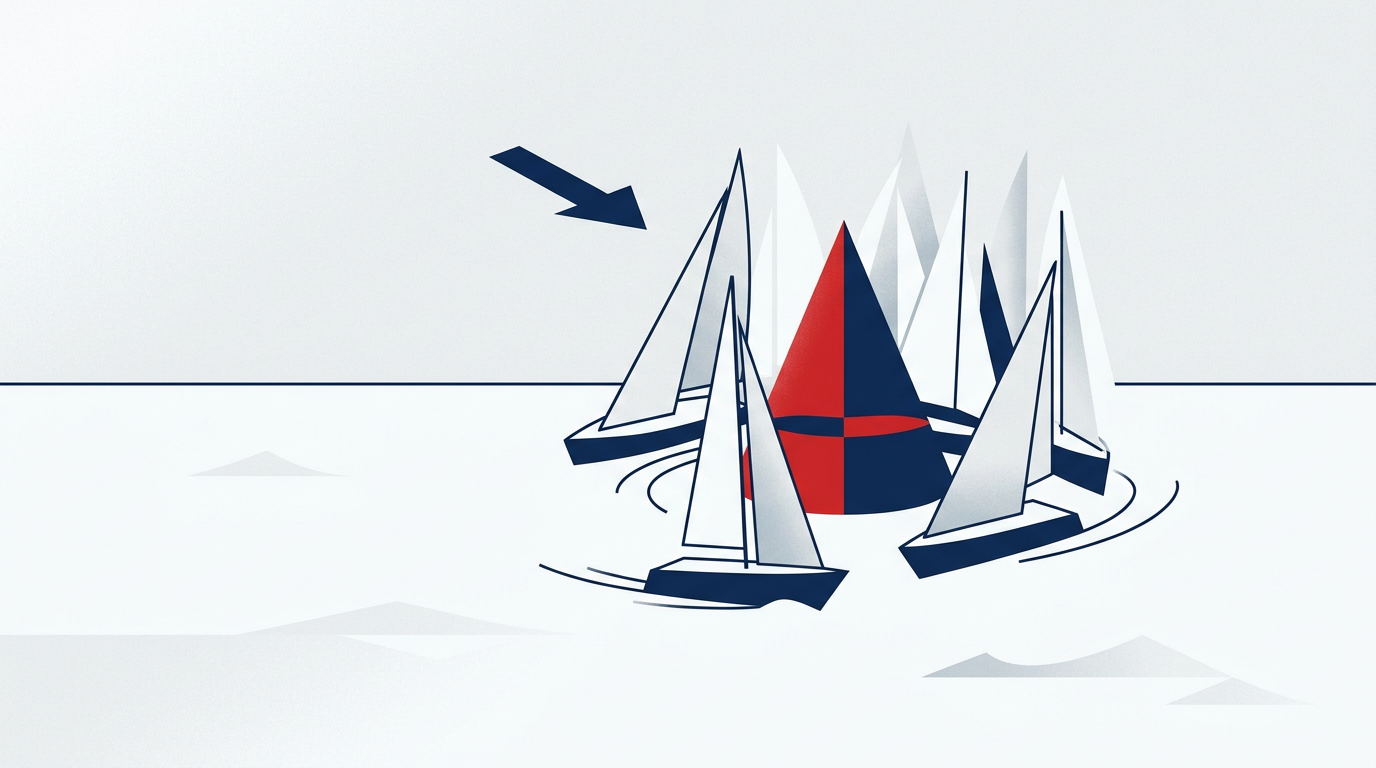
There is no place on a racecourse more claustrophobic than a windward mark during a crowded fleet race. Whether you are racing E-Scows on Lake Mendota or J/105s out of Milwaukee, the final fifty yards before the offset mark are where podium finishes go to die. When twenty boats converge on a single point of yellow plastic, the air gets dirty, the water gets choppy, and your margin for error shrinks to inches.
Over the years, I’ve seen many sailors lose three or four boats at the windward mark not because they were slow, but because they lacked a mechanical plan for the congestion. You cannot simply sail your normal line when three boats are stacked to windward and two are trying to squeeze in at the three-length zone.
Entering the Zone and Rule 18
Under the Racing Rules of Sailing (RRS), the 'Zone' is the area within three hull lengths of the mark. However, in crowded conditions, your tactical planning needs to start much further out. The most important rule to keep in mind here is Rule 18.2 (Giving Mark-Room). If you are overlapped on the inside when the first boat reaches the zone, you are entitled to room to round the mark.
But here is the catch: being 'right' under Rule 18 doesn't help you if you lose all your momentum. In a crowd, the boat that wins is the one that maintains flow. If you have to pinch to the point of stalling just to hold your spot, you’ve already lost. I tell my students to look for the 'low-road' approach if they aren't leading the pack. By staying slightly below the layline and coming in with speed, you can often hook into an inside overlap at the last second, forcing the boats above you to sail a longer distance.
Boat Handling Under Pressure
In Wisconsin lake racing, we often deal with 'puff and lull' cycles. If you hit a crowded mark during a lull, your boat handling must be whisper-quiet. The biggest mistake I see is 'over-steering.' When you are surrounded by other hulls, the natural instinct is to make sharp, jerky tiller movements to avoid contact. This acts like a brake.
Instead, use your weight and sail trim to steer the boat. As you prepare to bear away for the reach or run, ease the mainsheet slightly early. This helps the bow drop without having to slam the rudder over. If you are in a dinghy or a light keelboat, a subtle roll to windward will help the boat turn itself, preserving that precious kinetic energy you worked so hard to build on the beat.
Example: The Mendota Muck
I remember a Friday night race on Lake Mendota where the wind died to about four knots right as the top third of the fleet reached the windward mark. We were in a pack of six boats, all beam-to-beam. The boats that tried to 'win' the mark by pinching high ended up drifting into the mark or each other because they lost steerage way.
We decided to foot off early, giving up two boat lengths of distance to gain half a knot of speed. Because we had flow over the foils, we were able to tuck inside the pack at the three-length zone. While the others were struggling with Rule 18 disputes and stalled rudders, we glided through the gap. Safety at the mark isn't just about avoiding collisions; it's about keeping the boat moving so you have the power to steer away from trouble.
The Exit Strategy
Your rounding isn't finished until your sails are set for the next leg and you have clear air. In a crowd, everyone wants to bear away immediately. If you are the inside boat, you have the right to mark-room, but you don't have the right to sail whatever course you want if it interferes with a windward boat.
Once you clear the mark, check your exit. Often, the best move is to delay your hoist for five seconds to ensure you have a lane where you won't be blanketed by the pack behind you. In Great Lakes racing, where the chop can be significant, getting stuck in the 'gas' of the fleet after a mark rounding can feel like standing still while the world moves past you.
Safety First
Always remember Rule 14 (Avoiding Contact). No matter who has the right of way, you have a professional and sporting obligation to avoid a collision if possible. In a crowded rounding, keep your head out of the boat. The bow person should be calling out distances to other hulls, not just looking at the kite. Communication is the tool that keeps the fiberglass intact and the scoresheet clean.
Written by Dmitry Shteyn — Wisconsin sailor and educator. Find more sailing notes on the daily blog or read the longer guides.