Key takeaways
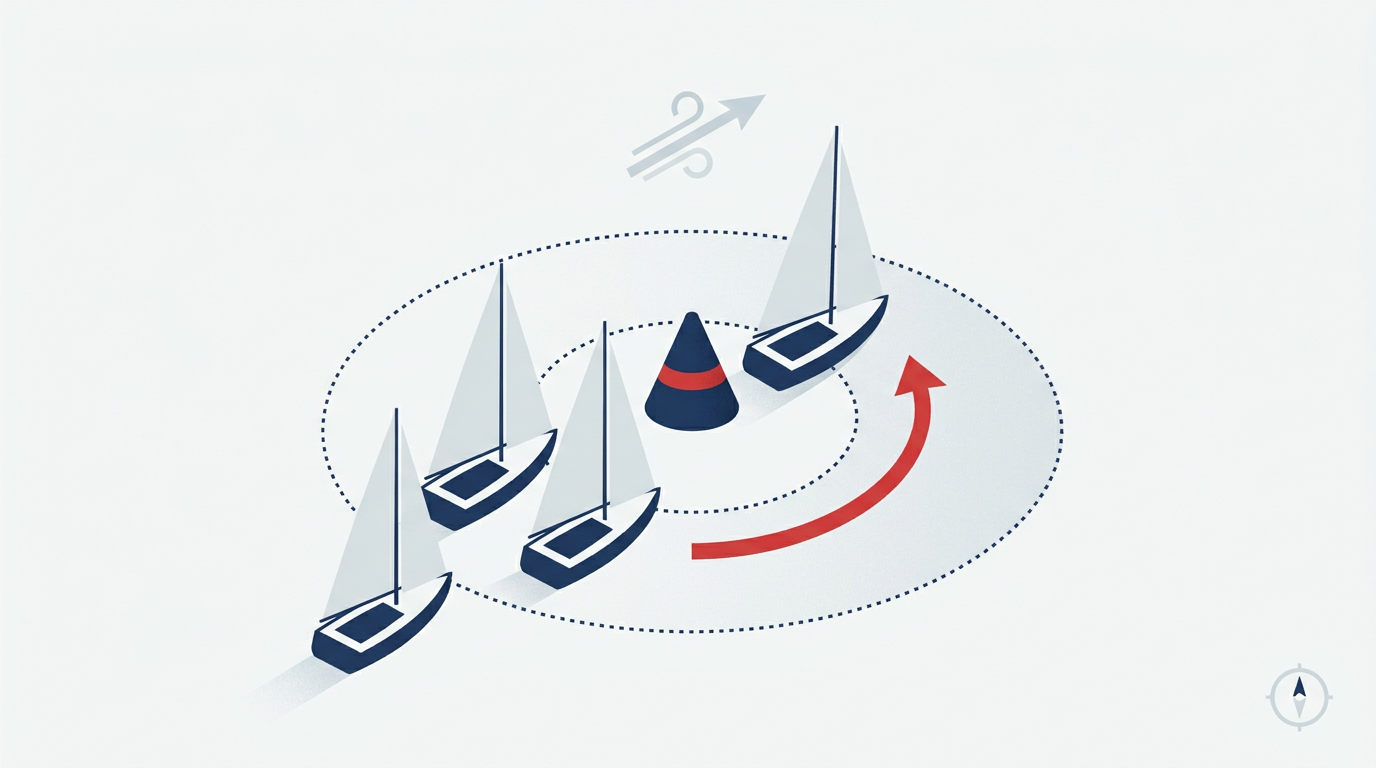
- The 'Zone' is defined as a three-hull-length radius around the mark.
- Overlap status is 'frozen' the moment the first boat's bow enters the zone.
- Rule 18 does not apply to boats on opposite tacks on a beat to windward.
- Inside boats are entitled to 'mark-room' to round in a seamanlike manner.
The Zone and the Right of Way
If you’ve spent any time racing on Lake Michigan or the inland lakes here in Wisconsin, you know that the most stressful three boat-lengths of any race occur at the marks. Whether it’s a crowded windward mark at the Oshkosh Yacht Club or a tight leeward gate during a Friday night offshore series in Milwaukee, Rule 18 of the Racing Rules of Sailing (RRS) is what keeps us from trading gelcoat.
At its core, Rule 18 governs "Mark-Room." It’s designed to ensure that boats can round a mark in a safe, seamanlike manner without being forced into the buoy or into another boat. However, it only switches on at a very specific moment: when the first of two boats enters the 'zone'—an imaginary circle around the mark with a radius of three hull lengths of the boat nearer to it.
Establishing the Inside Overlap
The most important question to ask as you approach the zone is: "Are we overlapped?" Under Rule 18.2(b), if boats are overlapped when the first one reaches the zone, the outside boat must give the inside boat mark-room.
I often tell my students that this isn't just about the physical space of the boat; it’s the space needed to round the mark in a "seamanlike way." This includes space to maneuver to the mark, and once there, space to sail to the mark and then space to sail your proper course while at the mark. If you are the outside boat, you are the "burdened" boat. You must stay clear enough that the inside boat doesn't have to dodge you to stay on course.
Example: A Tight Leeward Rounding on Lake Winnebago
Let’s look at a real-world scenario. Imagine you’re racing a Lightning on Lake Winnebago. You’re heading downwind toward the leeward mark on starboard tack. Another boat is slightly behind you but to your inside (closer to the mark).
As your bow crosses that three-length circle, the other boat has established an inside overlap. Even if you think you’re faster, Rule 18.2(b) is clear: you must give them room. In a stiff breeze, this means you might have to head up slightly earlier than you’d like to create a gap. If you squeeze them and they hit the mark or have to jibe to avoid you, you’re likely headed for a protest room loss.
The 'Shutting the Door' Myth
One common mistake I see in club racing is the attempt to "shut the door" after the lead boat has already entered the zone. Rule 18.2(c) explains that if a boat was clear ahead when she entered the zone, the boat that was clear astern at that moment must continue to give her mark-room.
If you are trailing a boat into the zone and managed to get an overlap after they are already inside those three lengths, you are not entitled to room. You are effectively the 'interloper.' In this case, if you try to wedge yourself between the lead boat and the buoy, you are breaking the rule. You must stay clear. If the lead boat wide-tacks, you still don't have a right to that inside gap unless they give it to you voluntarily.
When Rule 18 Does Not Apply
It’s just as important to know when Rule 18 shuts off. Rule 18.1 lists several exceptions. Most notably, it does not apply between boats on opposite tacks on a beat to windward. This is a huge point of confusion. If you are approaching the windward mark on port tack and another boat is approaching on starboard, Rule 18 does not give the port-tack boat any special rights. Rule 10 (On Opposite Tacks) takes precedence: the port-tack boat must keep clear of the starboard-tack boat, regardless of the zone.
Safety and Communication
In my classes, I always emphasize that while the rules provide the framework, communication prevents the collision. As you approach the zone, hail your intentions. Hailing "Room!" or "No Room!" early gives the other skipper time to react. On the Great Lakes, where waves can make boat handling unpredictable, giving a little extra margin for error is just good seamanship.
Remember, if you are forced to break a rule to avoid a collision (Rule 14), you must still fulfill your obligations, but the goal is always to keep the masts pointing up and the hulls scratch-free. Study Rule 18 until it’s second nature; it will make you a much more confident and aggressive (but fair) racer.
Written by Dmitry Shteyn — Wisconsin sailor and educator. Find more sailing notes on the daily blog or read the longer guides.