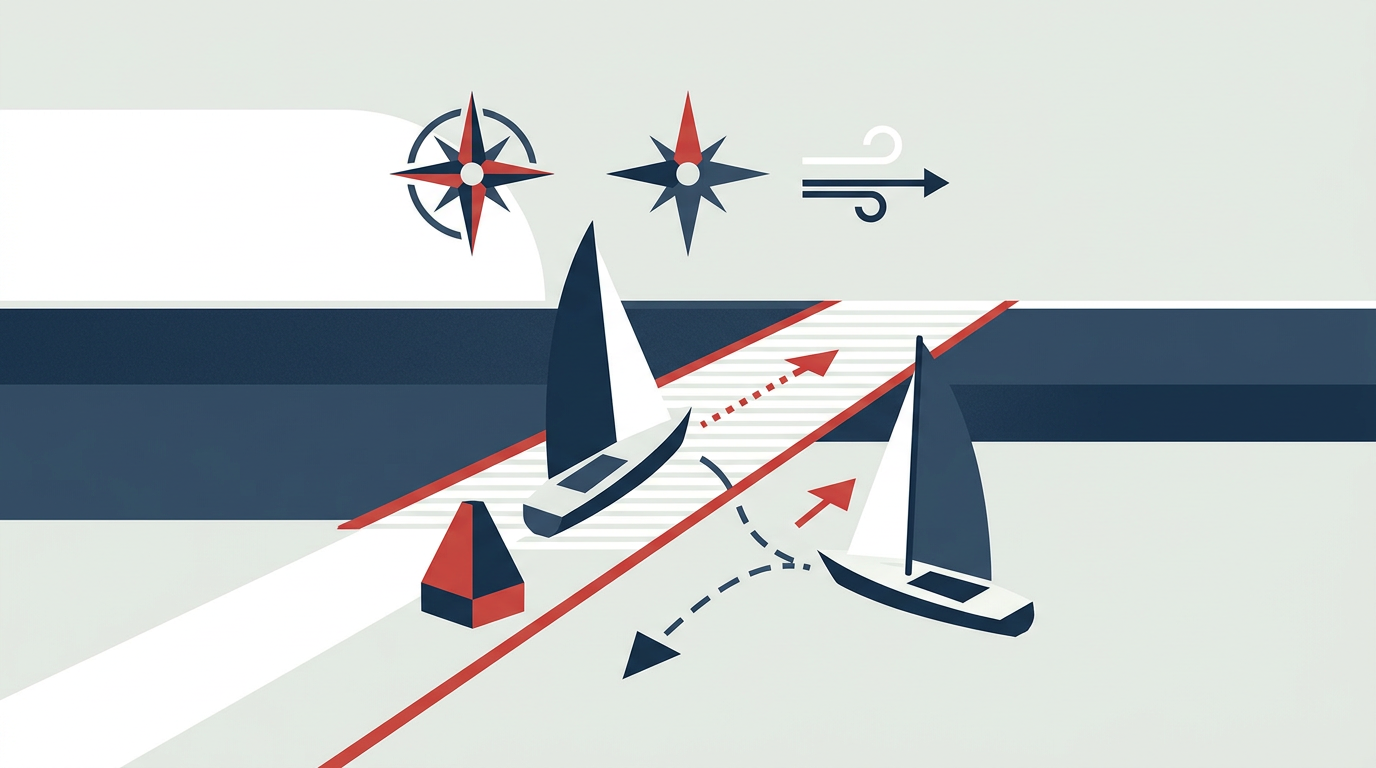
Key takeaways
- Rule 10: Port tack must always keep clear of starboard tack.
- Rule 11: When on the same tack and overlapped, the windward boat must keep clear of the leeward boat.
- Rule 12: A boat coming from behind (clear astern) must keep clear of the boat in front.
- Keeping clear means the right-of-way boat should not have to change course to avoid a collision.
The Foundation of Fairness on the Water
When I’m coaching sailors on Lake Mendota or out on the big water of Lake Michigan, I often see the same hesitation during crossings. Two boats are converging, the tension rises, and someone starts yelling. Most of the time, that stress comes from a lack of confidence in the 'Right of Way' rules—specifically Rules 10, 11, and 12 of the World Sailing Racing Rules of Sailing (RRS).
These three rules are the building blocks of every tactical interaction you will ever have on a racecourse. They aren't just there to prevent collisions; they are the tools we use to protect our air and force our opponents into difficult decisions.
Rule 10: On Opposite Tacks
This is the big one. Rule 10 states: 'When boats are on opposite tacks, a port-tack boat shall keep clear of a starboard-tack boat.'
In plain English, if your boom is on the port side (meaning the wind is coming over your starboard rail), you are the 'Right of Way' boat. If you are on port tack, the burden is entirely on you to stay out of the way.
I remember a regatta in Milwaukee where the chop was heavy and visibility was low. A port-tack J/105 tried to cross a starboard-tack boat, misjudged the wave set, and ended up having to tack right in the other boat's path. Because they failed to keep clear, they were immediately at fault under Rule 10. The key here isn't just 'don't hit them.' Keeping clear means the starboard boat should not have to change course to avoid you. If they have to flinch or luff to miss your stern, you haven't kept clear.
Rule 11: On the Same Tack, Overlapped
Once both boats are on the same tack—say, both on starboard heading toward the windward mark—Rule 10 no longer applies. Now we look at Rule 11: 'When boats are on the same tack and overlapped, a windward boat shall keep clear of a leeward boat.'
This is why we fight so hard for the 'leeward' position. If you are downwind of another boat and you have an overlap, you are the stand-on boat. You have the right to your lane, and the boat upwind of you must move to stay out of your way.
However, remember that Rule 16 also comes into play here: if you are the leeward boat and you decide to change course (like luffing up to squeeze the windward boat), you must give them 'room to keep clear.' You can't just jerk the tiller and force a collision; you have to give them the space and time to respond to your maneuver.
Rule 12: On the Same Tack, Not Overlapped
What happens if you are behind someone on the same tack? Rule 12 covers this: 'When boats are on the same tack and not overlapped, a boat clear astern shall keep clear of a boat clear ahead.'
This is a common point of contention in light-air racing on inland lakes. If you are catching a boat from behind, you are the 'clear astern' boat. You have no rights to the space they are currently occupied by. If you want to pass them, you have to choose to go above or below them. The moment you establish an overlap, the rule shifts from Rule 12 to Rule 11 (Windward/Leeward).
Real-World Application: The Cross or Tack Decision
Let’s look at a common scenario I see during our Wednesday night races. You are on port tack, approaching a starboard-tack boat. You think you can cross, but it’s going to be tight.
Under Rule 10, the risk is all yours. If you try to cross and the starboard boat has to head up to avoid hitting your transom, you have broken the rule. In a class race, this usually results in a two-turn penalty (Rule 44.1).
My advice? If you have to ask 'Can I cross?', the answer is usually 'No.' Instead of risking a protest or a collision, use the rules to your advantage. Duck the starboard boat (pass behind their stern). This keeps you in clean air and often positions you for a better tactical move on the next shift. By ducking, you are fulfilling your obligation under Rule 10 perfectly.
Safety and Sportsmanship
While these rules give one boat 'Right of Way,' Rule 14 always looms over us: 'A boat shall avoid contact with another boat if reasonably possible.' Even if you are on starboard tack and have every right to be there, you cannot intentionally sail into another boat.
Winning a race because you know the rules is great. Winning a protest because you got into a collision is expensive and dangerous. Use Rule 10, 11, and 12 to define your lanes, but always keep your eyes open for the boat that might not have seen you yet. Communication is your best safety tool—a loud, clear call of 'Starboard!' early on gives the port-tack boat plenty of time to fulfill their Rule 10 obligations without any drama.
Written by Dmitry Shteyn — Wisconsin sailor and educator. Find more sailing notes on the daily blog or read the longer guides.