Key takeaways
- Use the Bowline for loops that must stay open and remain easy to untie after heavy loading.
- Always put a Figure-Eight stopper knot at the end of sheets to prevent them from unreeving through blocks.
- The Round Turn and Two Half Hitches is more secure than a Clove Hitch for long-term mooring.
- Practice knots until they are muscle memory to ensure safety during high-stress maneuvers.
The Right Tool for the Task
One of the first things I tell my students at the sailing center is that a knot is never just a way to tie two things together. In the sailing world, a knot is a specific tool designed for a specific load and a specific consequence. If you use the wrong one, at best, you’ll struggle to untie it after a heavy blow on Lake Michigan. At worst, it will slip when you need it most, leading to a gear failure or a safety hazard.
On a boat, we generally categorize our needs into four buckets: loops that don't slip, stoppers to keep lines in place, hitches to secure lines to spar or dock, and bends to join two lines. Let’s break down the essential kit every sailor needs to have in their muscle memory.
The Bowline: The King of Knots
If you only learn one knot, make it the bowline. Its beauty lies in its reliability; it creates a fixed loop at the end of a line that will not slip or jam, regardless of how much tension is applied.
I primarily use the bowline for attaching sheets to the clew of a jib. During a heavy-air regatta on Lake Winnebago, I’ve seen makeshift knots pull tight and become impossible to undo, but a well-tied bowline can always be cracked open by pushing the 'doghouse' or the loop on the back. It’s also the primary knot for any emergency rescue scenario because it can be tied around a person’s waist without tightening under load.
The Figure-Eight: The Reliable Stopper
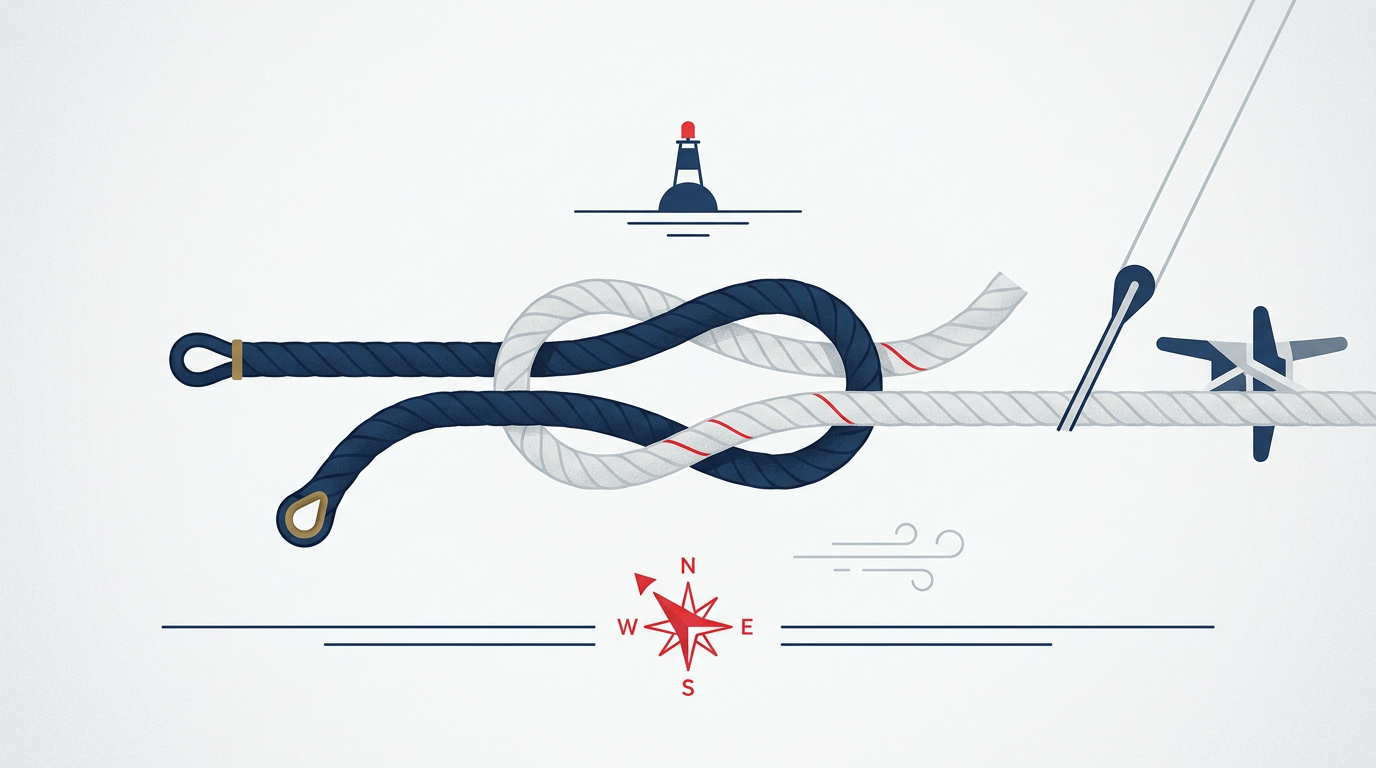
Every sheet and halyard on your boat should have a stopper knot at the tail end. The Figure-Eight is the gold standard here. Unlike a simple overhand knot, which can jam into a block so tightly you need pliers to get it out, the Figure-Eight provides enough bulk to stop the line from running through the lead while remaining easy to undo.
I’ve seen many races lost because a sailor forgot to check their jib sheet stoppers. During a chaotic tack, the lazy sheet runs through the fairlead, and suddenly the crew is scrambling to re-thread a line while the boat loses speed. Make it a habit to check these before you leave the dock.
The Clove Hitch and the Cleat Hitch
When it comes to securing the boat to something fixed, we look to hitches. The Clove Hitch is perfect for temporary jobs, like hanging a fender over the lifeline. However, it’s important to remember that a Clove Hitch can slip if the rope is very smooth or if the tension is inconsistent.
For permanent security, nothing beats the Cleat Hitch. Whether you are at a slip in Milwaukee or tied up at a pier on Lake Mendota, the sequence is the same: a full wrap around the base, a figure-eight over the horns, and a final tuck to lock it in. Avoid the temptation to add three or four extra 'locking' turns; they just make it harder for you or a dockhand to release the boat in a hurry.
The Round Turn and Two Half Hitches
When the wind picks up and you need to tie your boat to a piling or a ring, the Clove Hitch might not be enough. This is where the Round Turn and Two Half Hitches shines. By taking two full turns around the object first, you use friction to take the strain off the actual knot. This makes it much easier to tie and untie while the boat is pulling against you. It is arguably the most secure way to leave a boat unattended for a long period.
Knots and the Racing Rules
While knots themselves aren't explicitly governed by the Racing Rules of Sailing (RRS), their failure can lead to rule infractions. For example, if your jib sheet knot fails and your sail begins to luff wildly, obstructing another boat, you might find yourself in a situation involving Rule 14 (Avoiding Contact) or Rule 16 (Changing Course). A boat that is not under control due to poor knot-tying is a liability to the fleet.
Practice Until It’s Instinct
You shouldn't have to think about 'the rabbit coming out of the hole' when you're on a pitching deck in three-foot swells. You should be able to tie these knots in the dark, with wet hands, and while wearing gloves. Pick up a piece of scrap line while you’re watching the weather report tonight and practice until the muscle memory takes over. Your boat, and your crew, will thank you.
Written by Dmitry Shteyn — Wisconsin sailor and educator. Find more sailing notes on the daily blog or read the longer guides.