Key takeaways
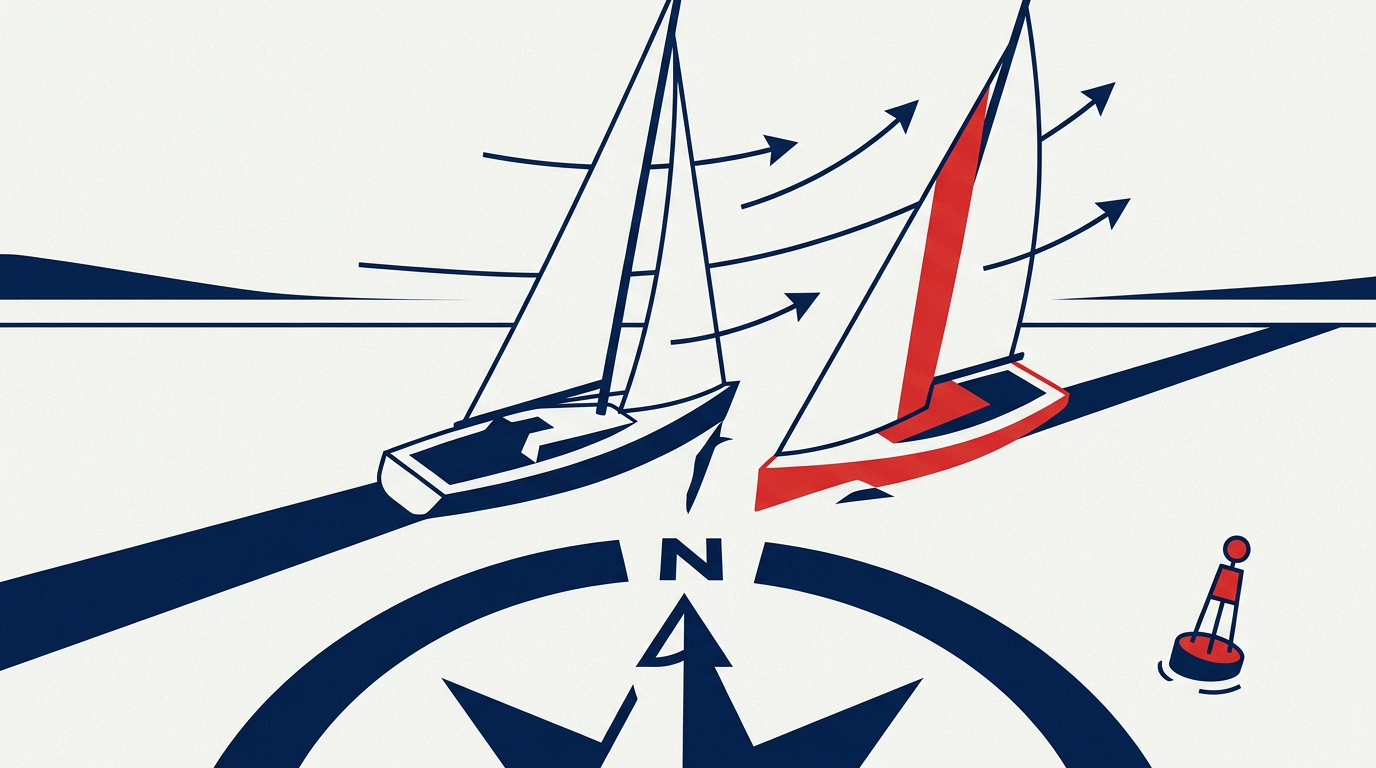
- Rule 10: Port-tack boats must always keep clear of starboard-tack boats in any crossing situation.
- Rule 11: If you are on the same tack and overlapped, the windward boat must keep clear of the leeward boat.
- Rule 12: If one boat is directly behind another on the same tack, the boat astern must not hit the boat ahead.
- Decision Timing: When on port tack, decide to cross, duck, or tack at least four boat lengths before the encounter.
The Foundation of Fairness
When we talk about the Racing Rules of Sailing (RRS), the section on 'Right of Way' is our constitution. It defines who moves and who stays their course to prevent collisions. For sailors on Lake Michigan or our inland lakes like Lake Mendota, understanding the nuances of rules 10, 11, and 12 is not just about winning—it is about safety. When two boats are closing at 12 knots on a combined heading, things happen fast. If you don't know your rights instantly, you risk a fiberglass-crunching disaster.
Rule 10: On Opposite Tacks
This is the big one. Rule 10 states: 'When boats are on opposite tacks, a port-tack boat shall keep clear of a starboard-tack boat.'
It sounds simple, but in the heat of a regatta, the 'starboard' shout can be intimidating. A boat is on starboard tack when its windward side is the port side—or more simply, when the boom is on the port side. If you are on port tack, the burden is entirely on you. You must act early enough that the starboard boat does not have to alter course to avoid you.
I remember a race off Milwaukee during a heavy-air blow. I was on port, looking at a wall of starboard boats coming off the line. Because I couldn't cross, I had to make the decision early: do I tack or do I duck? Waiting until the last three boat lengths to decide is a recipe for a foul or a collision. Rule 10 is absolute; if the starboard boat has to flinch, you’ve broken the rule.
Rule 11: On the Same Tack, Overlapped
Once we are all on the same tack—say, a long drag race toward the shore on a starboard tack—Rule 11 takes over: 'When boats are on the same tack and overlapped, a windward boat shall keep clear of a leeward boat.'
In this scenario, the boat 'downwind' (the leeward boat) has the right of way. As the leeward boat, you have the right to sail your course, and the windward boat must move to stay out of your way. However, there is a catch: Rule 16 reminds us that if you change course, you must give the other boat room to keep clear. You can't just luff suddenly and clip their transom.
Rule 12: On the Same Tack, Not Overlapped
What happens when one boat is directly behind another? Rule 12 covers this: 'When boats are on the same tack and not overlapped, a boat clear astern shall keep clear of a boat clear ahead.'
This is common during downwind legs or approaching a starting line. If you are trailing someone, you are the 'burdened' vessel. You cannot run into their transom. If you are the boat ahead, you have the right of way, but again, you cannot maneuver in a way that prevents the boat behind from keeping clear if they are close.
Real-World Application: The Cross or Duck
Let’s look at a typical crossing on a beat. You are on port tack, approaching a starboard-tack boat. You have three choices:
- The Cross: If you are 100% sure you can pass in front without the starboard boat slowing down or changing course, go for it. But be warned: if they have to head up even a few degrees to miss your stern, you have fouled them under Rule 10.
- The Duck: You head down, pass behind their transom, and keep your speed. This is often the tactically safer move to stay in clear air.
- The Tack: You tack into a leeward position. If you do this, you must complete your tack without forcing the other boat to move (Rule 13), and then Rule 11 (leeward/windward) will apply.
The Concept of 'Keeping Clear'
A common mistake I see in my coaching clinics is a misunderstanding of what 'keeping clear' means. According to the RRS definitions, a boat keeps clear if the right-of-way boat can sail her course with no need to take avoiding action.
In a recent E-Scow race on Lake Beulah, I saw a port boat try to squeeze a cross. The starboard boat didn't hit them, but they had to ease their main and head up to avoid a collision. The port boat was disqualified because they forced the right-of-way boat to change their 'proper course.' Safety is the priority; if you are in doubt on port tack, always duck. It's much faster than doing two 360-degree penalty turns.
Communication is Key
While the rules are clear, communication prevents protests. If you are the starboard boat and it looks close, a loud, clear yell of 'Starboard!' lets the other boat know you see them and intend to hold your course. If you are the port boat and you are ducking, a shout of 'Ducking you!' or 'Cross!' (if you are clearly ahead) helps the starboard boat stay calm and focused on their own speed rather than wondering if a collision is imminent.
Written by Dmitry Shteyn — Wisconsin sailor and educator. Find more sailing notes on the daily blog or read the longer guides.