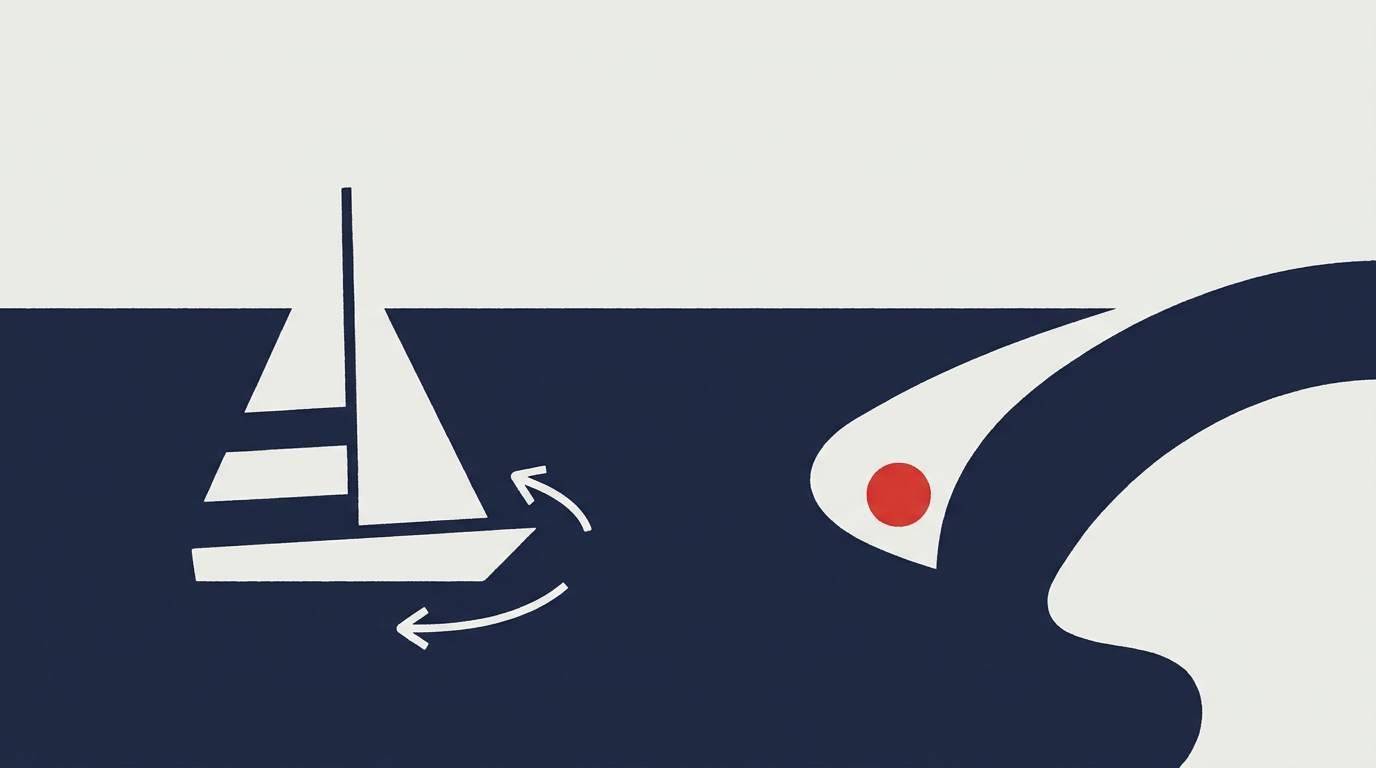
Key takeaways
- Identify 'The Funnel': Current is strongest at breakwall gaps where water is forced through narrow openings.
- Avoid the Washing Machine: Stay away from vertical bulkheads during heavy swell to avoid momentum-killing reflected waves.
- Use SOG to find eddies: Compare boat speed to Speed Over Ground to identify areas where current is weaker or reversed near the shore.
- River Discharge: In river-fed harbors, stay in shallow water when sailing upwind to avoid the strongest outflow current.
The Hidden River Inside the Harbor
When most sailors think of Lake Michigan, they think of big swell and the vast open horizon. But many of our best local regattas take place just inside or right at the mouth of the massive stone breakwalls that protect cities like Milwaukee, Chicago, and Kenosha. Racing in these confined areas introduces a variable that many Lake Michigan sailors overlook: harbor current and shoreline reflection.
While the Great Lakes don't have lunar tides, we have significant water movement driven by wind stress and river discharge. When you are racing inside a harbor, the breakwalls act like the banks of a river. The water has to go somewhere, and the geometry of the shoreline dictates exactly how that current will impact your boat speed and your tactical decisions.
The Funnel Effect at the Gap
One of the most common scenarios we face in Milwaukee is racing near the "Main Gap." On a day with a strong northeasterly blow, the lake is pushing a massive volume of water against the shoreline. That water enters the harbor through the northern openings and seeks an exit. As a result, you often find a significant southbound current ripping through the gap.
I remember a specific Wednesday night race where the windward mark was tucked just inside the breakwall. The fleet split; those who headed out toward the gap found themselves standing still. Even though they had slightly better pressure, they were sailing into a two-knot current exiting the harbor. The boats that stayed closer to the city shoreline found an eddy—a spot where the water was relatively still or even circulating back upwind.
In these situations, your GPS SOG (Speed Over Ground) becomes your best friend. If your boat speed through the water is 5.5 knots but your SOG is 4.0, you are fighting a treadmill. It’s time to head toward the shore where friction and shallower water slow the current down.
Shoreline Reflection and the "Wall Wave"
It isn't just the water moving under the hull that matters; it’s how the water moves against the vertical surfaces of the harbor. When you race close to a concrete or steel bulkhead, you have to deal with reflected waves. These are waves that hit the wall and bounce back, creating a "washing machine" effect where the incoming and outgoing waves collide.
This chop is erratic and saps your momentum. When I’m coaching sailors in these conditions, I tell them to avoid the "dead zone" within 50 to 100 feet of a vertical wall if there is any significant swell. The energy reflected off the wall will kill your VMG (Velocity Made Good). However, if the water is flat, that same wall might offer a massive tactical advantage by providing a "header" as the wind is forced to turn and run parallel to the obstruction.
River Discharge and Temperature Toggles
In harbors like Racine or Sheboygan, where a river flows directly into the racing area, the current isn't just a physical force—it’s a temperature marker. Cold river water meeting the warmer lake water (or vice versa) creates distinct lines in the water.
From a tactical standpoint, river water is often less dense (freshwater vs. the slightly more mineral-heavy lake water, though the difference is subtle) and carries silt. More importantly, the current from the river will almost always be strongest in the deepest part of the channel. If you are racing upwind against a river outflow, you must stay in the shallows. Under the Racing Rules of Sailing, specifically Rule 18 (Mark Room), navigating these shallow areas near marks requires precision. You don't want to get pinned against a pier head while fighting a river current; you lose all maneuverability.
Tactical Summary for Harbor Starts
When the RC sets the start line inside a harbor, your pre-race routine must include a "drift test."
- Stop the boat: Head into the wind near the start line and look at a fixed object like a channel marker or a buoy.
- Check your SOG: If you are stationary but your GPS shows 0.5 knots, you have current. Note the direction.
- Identify the relief: Look at the shoreline. Is there a cove or a shallow shelf where the current might be weaker?
In a crowded harbor start, the current will often push the entire fleet toward the favored end. If the current is pushing you over the line (over early), you need to stay half a boat length further back than usual. Conversely, if you are fighting a current pushing you away from the line, you need to pull the trigger much earlier than your standard 10-second countdown.
Safety is paramount here. Harbor walls are unforgiving. Always ensure your crew is aware of the depth and the proximity of submerged rip-rap, which often extends further from the visible wall than you might expect. Keep your eyes out of the boat, monitor your SOG, and use the shoreline geometry to your advantage rather than letting it dictate your race.
Written by Dmitry Shteyn — Wisconsin sailor and educator. Find more sailing notes on the daily blog or read the longer guides.