Key takeaways
- Always approach your target on a close reach to allow for easy speed adjustment by sheeting in or out.
- Use the 'shoot'—turning directly into the wind—to bleed off final momentum before reaching the target.
- Back the mainsail or jib to create sternway (backward movement) to set an anchor or move away from a dock.
- Practice in open water with a buoy to learn your boat's specific coasting distance in different wind strengths.
The Lost Art of the Silent Approach
Most modern sailors rely heavily on their iron breeze—the engine—when it comes time to finish the day. Whether you are dropping an anchor in a quiet cove or picking up a mooring ball at a yacht club, the motor provides a safety net. But what happens if that engine fails, or if you are racing a classic boat that doesn't have one?
Learning to anchor, moor, and dock under sail alone isn't just a survival skill; it is the ultimate test of your boat handling. It requires you to synthesize everything you know about sail trim, momentum, and windage into one final, quiet maneuver. In Wisconsin, where we often deal with puffy, unstable inland winds or the steady but powerful draw of Lake Michigan, being able to stop on a dime is a hallmark of a skilled mariner.
Anchoring Under Sail: The Controlled Drift
The goal of anchoring under sail is to arrive at your chosen spot with zero headway just as the anchor hits the bottom, then use the wind to back the boat away to set the hook.
On a recent afternoon on Lake Mendota, I watched a student try to anchor a Flying Scot. They sailed into the wind on a close reach toward their target, but they held onto their speed too long. By the time they headed into the wind to drop the anchor, they had so much momentum they sailed right over the hook, tangling the line in the centerboard.
To do this correctly, you must plan your approach on a reach. A reach is your 'escape' gear; you can power up by sheeting in or kill speed by letting the sails luff. As you approach your spot, head up into the wind (the 'shoot') and douse or furle the headsail. The mainsail should be loose. When the boat stops moving forward, drop the anchor. Then, back the jib or push the main boom forward to force the boat to sag backward, ensuring the anchor flukes dig into the Wisconsin mud.
The Mooring Pick-up: Finding the Stall
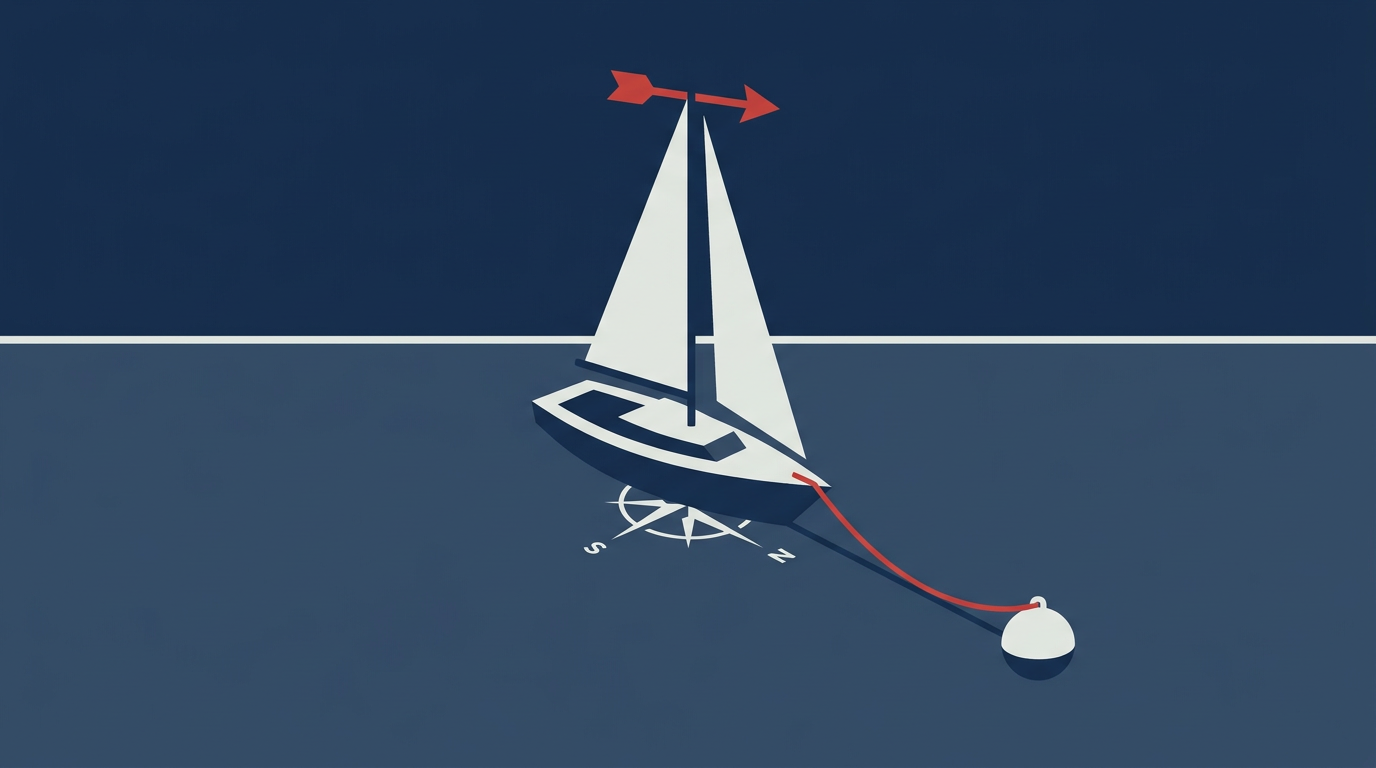
Mooring under sail is even more precise because your target is fixed. You don't have the luxury of drifting; you have to stop the bow exactly over the buoy so your crew can grab the painter.
- Scope the wind: Determine exactly where the wind is coming from.
- The Approach: Approach the buoy on a close reach. This allows you to control your speed perfectly. If you are going too fast, ease the sheets. If you are stalling too early, trim in.
- The Final Turn: When you are about two boat lengths away (depending on your boat's weight and the wind strength), turn the bow directly into the wind.
- The Kill: As the boat glides to a stop, the sails should be shivers. The crew grabs the buoy.
If you miss, do not panic. Do not try to force it. Immediately bear away, regain steerage way, and circle back for another try. Rule 14 of the Racing Rules of Sailing reminds us to avoid contact whenever possible; this applies just as much to harbor buoys and stone piers as it does to other racing boats.
Docking Without the Iron Breeze
Docking is the high-stakes version of this maneuver because docks don't move and they are usually surrounded by expensive fiberglass. The key here is the 'leeward' approach whenever possible. If the wind is blowing off the dock, you can sail in slowly and let the wind act as your brake.
I remember a delivery trip into McKinley Marina in Milwaukee during a breezy Northeaster. The engine wouldn't start, and we had to get a 35-foot keelboat into a tight slip. We used only the mainsail. By keeping the main traveler all the way down and the sheet eased, we could 'vamp' the power. We aimed for a spot slightly upwind of the slip, and as we lost steerage, the wind pushed us gently sideways toward the pilings.
Safety and Legal Considerations
When practicing these maneuvers, safety is paramount. Always have an anchor ready to drop instantly if things go wrong. Under the Racing Rules of Sailing, specifically Rule 45, a boat must be seen to be moored or anchored properly if they are choosing to wait out a storm or a lull during a race. Furthermore, knowing how to stop your boat under sail is a fundamental requirement for the US Sailing Small Boat Instructor certification, and for good reason—it prevents accidents when mechanical systems fail.
Practice in open water first. Throw a life ring or a buoy out and practice 'docking' next to it until you can gauge your boat's coasting distance to within a few feet. Every boat is different; a heavy Pearson will carry its way much longer than a light dinghy.
Written by Dmitry Shteyn — Wisconsin sailor and educator. Find more sailing notes on the daily blog or read the longer guides.