Key takeaways
- Execute an immediate tack without releasing the jib to kill boat speed and stay near the victim.
- Assign a dedicated 'pointer' who never takes their eyes off the person in the water.
- Approach the victim on a close reach to maintain speed control by feathering the sails.
- RRS Rule 1.1 mandates that helping someone in danger is the absolute priority over the race.
The Importance of the Immediate Turn
There is no sound more chilling on a boat than the shout of "Man Overboard!" Whether you are racing on a Friday night in Milwaukee or cruising across Lake Winnebago, the reality is that the water in Wisconsin is often cold enough to induce shock quickly. When a crew member hits the water, your first and most important job is to stay close.
In my years of teaching, I’ve seen too many sailors panic and sail away from the victim while trying to figure out a complex recovery pattern. The most effective method under sail is the Quick-Stop. It keeps the boat near the person in the water and minimizes the risk of losing sight of them, especially in the chop of Lake Michigan.
Step-by-Step: The Quick-Stop Execution
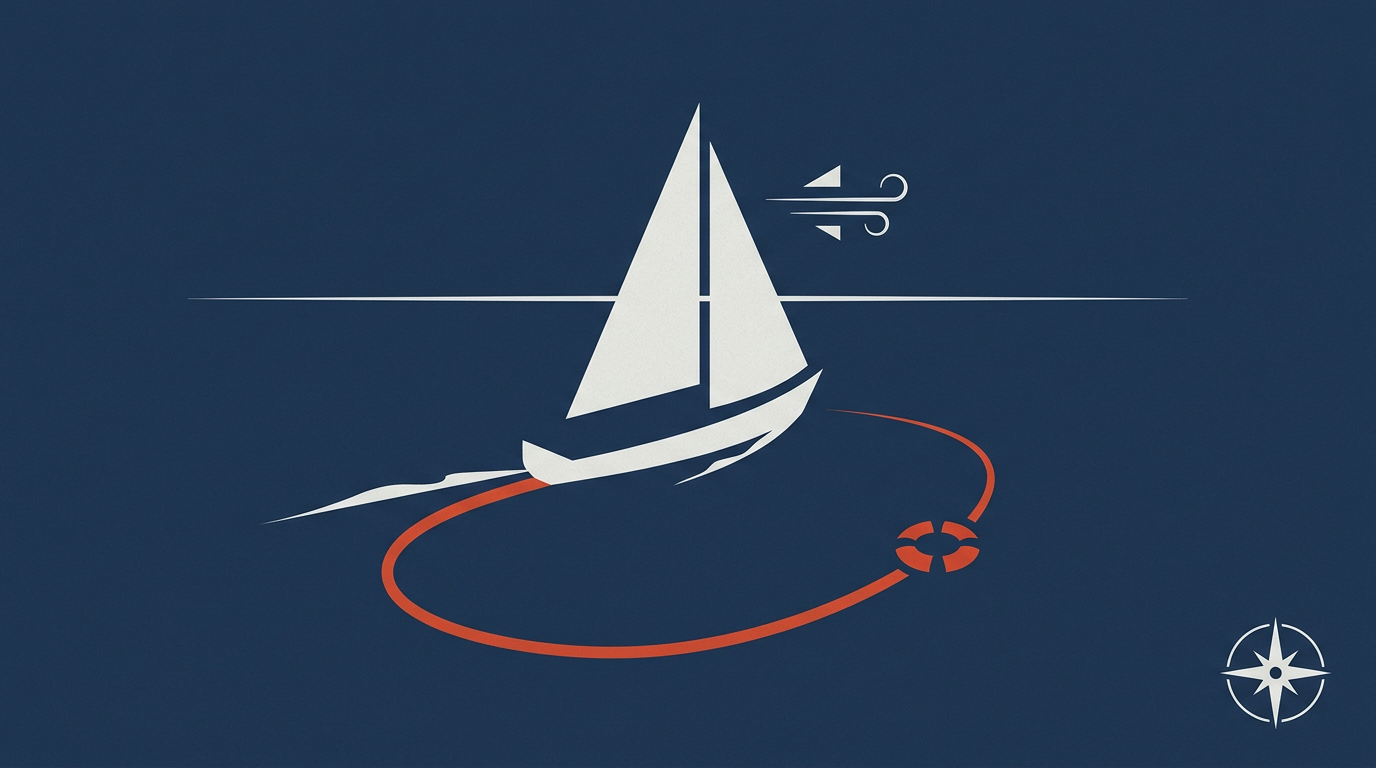
As soon as the person goes over, the helm needs to bring the boat head-to-wind and beyond. If you are sailing upwind, this is essentially a tack without releasing the jib. By leaving the jib backed, the boat loses headway rapidly.
- Shout and Pointer: Someone must immediately shout "Man Overboard!" and one person should be assigned to do nothing but point at the victim. Never take your eyes off them.
- The Turn: Bring the boat through the eye of the wind. Don't touch the sheets yet. The backed jib will help the bow swing and kill your speed.
- The Circle: Once the boat has turned through the wind, you’ll be on a broad reach or a run. Keep the boat within a two-boat-length radius of the victim.
- The Approach: You want to approach the person from a close-reach position. This is the "safety zone" where you can spill air from your sails to control your speed or power up if you are falling short.
A Real-World Example on Lake Michigan
I recall a practice session off McKinley Marina a few years back. We were pushing a J/105 hard in about 18 knots of breeze. During a particularly clumsy tack, a bowman lost his footing and went over the lifelines.
Because we were practicing drills that week, the helmsman didn't hesitate. He jammed the tiller down, tacked the boat, and kept the headsail cleated. The boat slowed from 7 knots to a crawl in seconds. Because we stayed in a tight circle, we were back alongside him in under two minutes. Had we continued for even thirty seconds to "prepare" the boat, the waves would have made spotting his head in the swell significantly harder.
Handling the Sails and Gear
In a racing environment, you might have a spinnaker up. This complicates things significantly. Under World Sailing’s Racing Rules of Sailing (RRS 1.1), a boat must give all possible help to any person or vessel in danger. This means the race effectively stops for you. Forget the kite. Blow the halyard, get the cloth in the boat (or at least out of the water), and get the boat back under control.
If you are using the Quick-Stop, you don't necessarily need to drop the mainsail, but you must be able to depower it. Ensure your mainsheet is ready to run so that when you pull alongside the victim, the boat can come to a dead stop.
The Final Connection
When you make your final approach, always try to pick the person up on the windward side if the conditions allow it, or be very careful about the boat drifting over them. However, in heavy Lake Michigan chop, many instructors prefer the leeward side to create a "lee" (a calm patch of water) for the victim. The danger there is the boat rolling down onto the person.
Whichever side you choose, the goal is a dead stop. You are not "sailing past" them; you are stopping next to them. If you miss, don't try to fish for them with a boat hook—you'll likely just cause injury. Circle back and try the approach again.
Safety and Legal Responsibility
Beyond the moral obligation, RRS Rule 41 (Outside Help) notes that a boat that provides help to a person in danger may be entitled to redress, but the priority is always the recovery. Practice this drill until it becomes muscle memory. Use a life jacket with a weighted jug attached during your next club practice. It’s the one skill you hope you never have to use, but it’s the most important one you’ll ever learn.
Written by Dmitry Shteyn — Wisconsin sailor and educator. Find more sailing notes on the daily blog or read the longer guides.