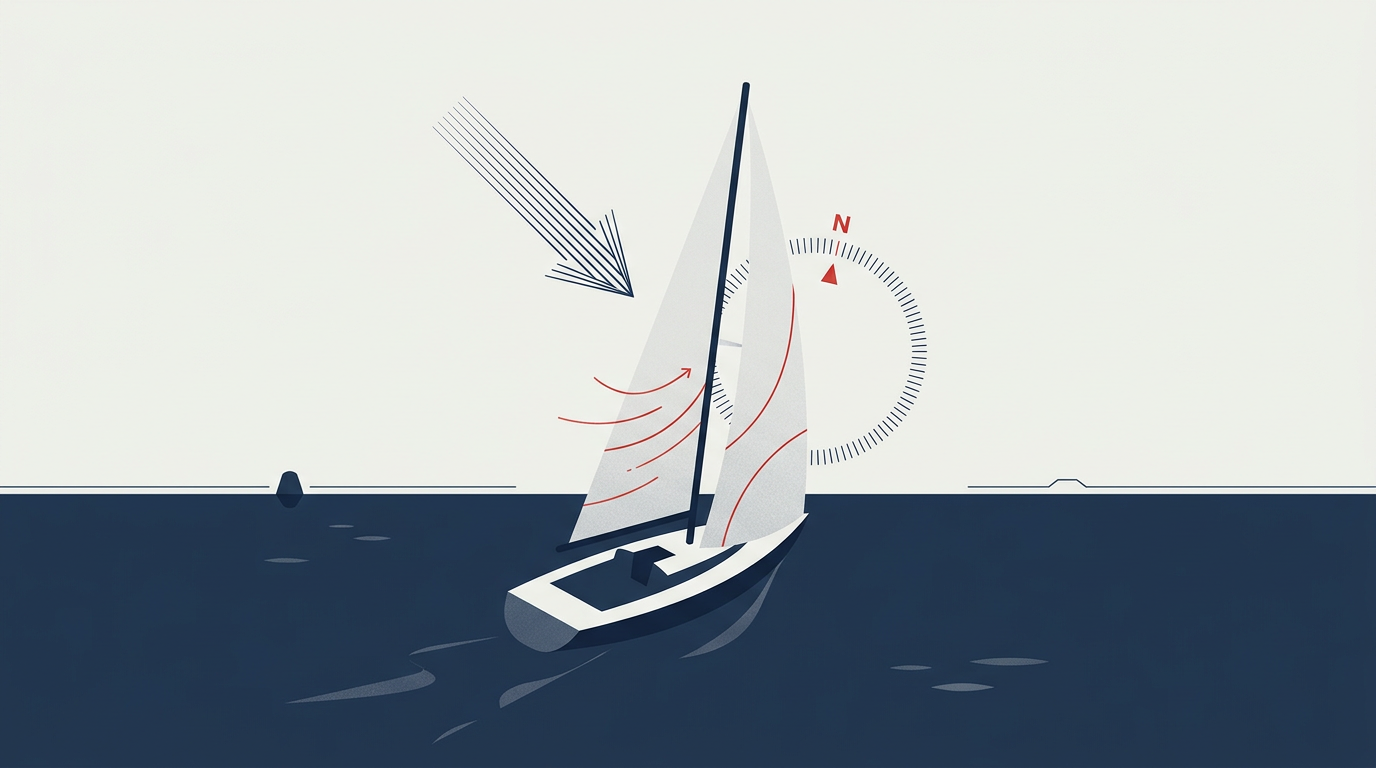
Key takeaways
- Ease halyards until slight wrinkles appear to keep the sail entry round and powerful.
- Move jib leads forward one or two holes to increase power in the bottom of the sail.
- Keep the top batten parallel to the boom; over-sheeting stalls the sail in low energy wind.
- Use leeward heel to let gravity shape the sails when the wind is too weak to do it.
The Psychology of Light Air Trim
When the wind drops below six knots on Lake Michigan, most sailors have a physical reaction to pull everything tight. We want to feel the boat move, so we over-trim in hopes of generating tension. As a coach, I see this more than any other mistake. In light air, tension is your enemy. You aren't looking for a stiff, flat sail; you're looking for an airfoil that can breathe.
Yesterday, we were out near the Milwaukee breakwall in a dying northeasterly. The water was glassier than a pond in Waukesha, and the boats that stayed moving were the ones that weren't afraid to look 'sloppy.' To find your speed in these conditions, you need to abandon your heavy-air settings and find a new set of baseline numbers for your trim.
The Jib: Creating the Entry
In light air, the air has very little energy. It cannot easily flow around sharp corners or heavy bends. This means your jib lead position is critical. If your leads are too far aft, the foot will be tight but the top will wash out. If they are too far forward, you’ll choke the exit.
My rule of thumb for light air upwind is to move the jib leads forward one or two holes from your neutral setting. This puts more 'round' in the bottom of the sail. You want a deep, powerful entry. However, you must be careful not to over-sheet. In light air, the telltales are your best friends. If the windward telltale stalls, you're pinching. If the leeward one stalls, you've over-sheeted and stalled the entire sail.
Maintrack and Sheet Tension
On the mainsail, the most important number is your traveler position. In five knots of wind, you want the boom on the centerline, but you want the mainsheet soft enough that the top batten is parallel to the boom—or even slightly open.
On many boats I coach in the Wisconsin Interlake classes, sailors forget that the weight of the boom itself provides tension. In very light air, the boom might be heavy enough to stall the top of the main on its own. You might actually need to pull the traveler slightly above the centerline while easing the mainsheet to keep the boom from falling away, while still maintaining an open leech.
The Magic of Sags and Wrinkles
We are taught that sails should be smooth, but in light air, 'smooth' usually means 'too tight.' Look at your halyard tension. If you see vertical wrinkles along the luff, that’s actually okay in under five knots. It means you haven't pulled the draft too far forward, which would flatten the entry.
You also want to look at your forestay sag. On a fractional rig, easing the backstay allows the forestay to sag. This creates a deeper, more powerful jib shape. Just remember, as the wind picks up even slightly—say from three knots to six—you have to take that sag back out, or you’ll lose your ability to point.
Concrete Example: The Inland Lake Drifter
I remember a race on Lake Mendota where the breeze was so light we could see the puffs coming by the way the water changed color from gray to slightly darker gray. One boat was consistently faster. When I looked at their rig, their jib halyard was loose enough to show small horizontal wrinkles, and their crew was sitting on the leeward floorboards to induce a permanent heel.
By inducing heel, they used gravity to help the sails take their shape. Without that heel, the sails would just hang limp. They weren't worried about the 'perfect' look; they were worried about flow. They kept their eyes on the top batten telltale. If that string disappeared behind the sail, they immediately eased the sheet an inch. That one inch was the difference between 2.5 knots of boat speed and 1.8 knots.
Staying Legal and Safe
When you are focused intensely on these micro-adjustments, don't forget the Racing Rules of Sailing (RRS). Under Rule 42 (Propulsion), you must be careful not to 'pump' the sails. In light air, it’s tempting to fan the main to get moving, but repeated fanning that isn't in response to a wave or a gust is a violation.
Safety-wise, light air is deceptive. You might feel fine, but the sun is just as hot and the dehydration just as real. Keep the crew hydrated while you're hunting for those puffs. The boat that stays focused the longest usually wins the drifter, and you can't focus if you're heat-exhausted.
Summary Checklist
- Move jib leads forward to round up the foot.
- Keep the traveler high and the sheet soft to keep the leech open.
- Induce heel to leeward to help the sails set.
- Minimize crew movement to avoid breaking the delicate airflow.
Written by Dmitry Shteyn — Wisconsin sailor and educator. Find more sailing notes on the daily blog or read the longer guides.