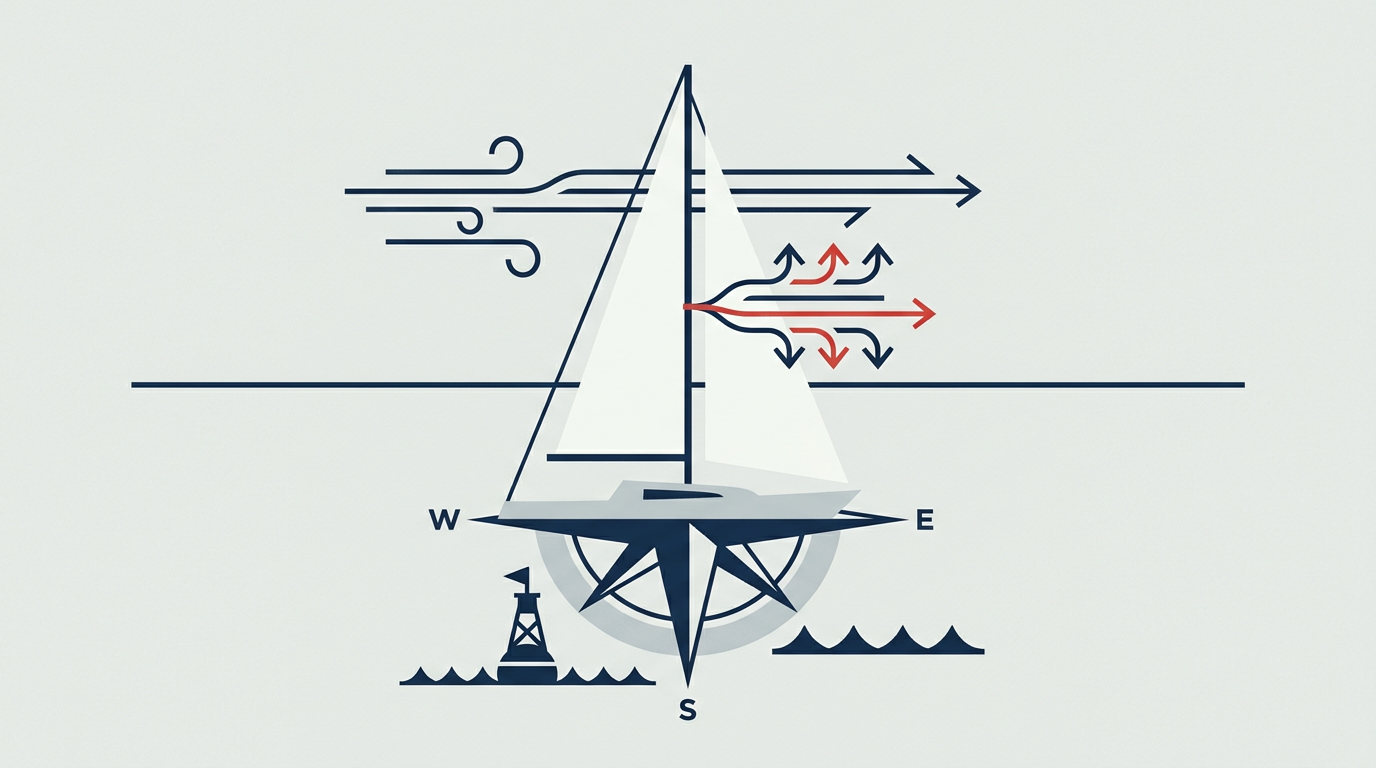
Key takeaways
- Dampen your reactions: Don't jerk the tiller at every telltale flutter; wait for a consistent trend before adjusting.
- Instruments are lag indicators: Use them to confirm your 'feel,' but prioritize the physical conditions like wave chop over digital targets.
- Follow the 10% rule: Spend no more than 10% of your time looking at electronics to maintain tactical and safety awareness.
- Minimize rudder drag: Over-steering to chase 'perfect' trim often slows the boat more than a slight trim error would.
The Trap of the Digital Dashboard
I often see sailors on Lake Michigan get so locked into their speedo and wind displays that they might as well be playing a video game. In the coaching world, we call this 'sailing in the box.' When you stare at the numbers or the telltales for too long, you lose your peripheral vision, your sense of the waves, and your awareness of the fleet.
Instruments and telltales are vital tools, but they are lag indicators. They tell you what happened a second ago, not what is happening right now. To sail fast without 'over-sailing'—which is the act of making too many small, jerky corrections that kill your momentum—you need to learn how to use these tools as a pulse check rather than a steering wheel.
Trusting the Telltales Without Chasing Them
Telltales are your most immediate feedback for sail trim. On a beat up toward the Milwaukee breakwater, your jib telltales tell you if you are in the 'groove.' However, many helmsmen make the mistake of chasing the inner telltale the moment it flutters. If you see the windward telltale lift, and you immediately crank the tiller to head up, you often overshoot the mark.
Over-sailing happens when you react to every tiny ripple in the airflow. Instead, use a 'damped' approach. If the telltale lifts, wait half a heartbeat. Is the boat feeling sluggish? Is the heel angle changing? If the answer is yes, then make a smooth, controlled turn. On inland lakes like Lake Winnebago, where the wind is notoriously shifty, chasing every telltale flutter will result in a 'snake' path through the water, adding extra distance and drag from the rudder.
The Role of Instruments in the Great Lakes
When we are out on the open water of Lake Michigan, instruments become more important because we lack visual references. Target boat speed and True Wind Angle (TWA) are your benchmarks. But here is the secret: you shouldn't be trying to hit your targets 100% of the time.
If your targets say you should be doing 6.8 knots at 38 degrees TWA, and you are currently doing 6.5 knots, don't just shove the nose down. Look at the waves. If you are sailing into a square chop, you need to sail 'fat' (lower and faster) to punch through. If you blindly follow the instrument's suggested angle, you will stall out against the waves. This is the definition of over-sailing—letting the data override the physical reality of the environment.
A Real-World Example: The Mendota Light Air Struggle
I remember a regatta on Lake Mendota where the breeze was hovering around 4-6 knots. One of my students was glued to his Windex and his jib telltales. Every time a puff hit, he would head up sharply to keep the telltales streaming. The problem? Every time he moved the rudder that aggressively, he slowed the boat down more than the lift helped him.
We talked about 'sailing by the lee of the telltale.' In light air, it is often better to have the windward telltale dancing slightly upward while keeping the boat steady. By reducing rudder movement, we kept the flow attached to the foils. We stopped over-steering and started focusing on the pressure on the water ahead. The boat speed jumped by half a knot simply because we stopped trying to be 'perfect' with the ribbons.
Rules and Safety: Staying 'Heads Up'
Over-sailing isn't just a speed killer; it’s a safety hazard. Under the Racing Rules of Sailing (RRS), specifically Rule 10 (On Opposite Tacks) and Rule 11 (On the Same Tack, Overlapped), you are responsible for maintaining a lookout and avoiding collisions. If your head is down in the cockpit looking at a TackTick or a Velocitek, you aren't seeing the starboard-tack boat converging on you at 10 knots.
Safety is paramount. Your scan should be: Telltales (1 second), Horizon/Waves (5 seconds), Compass/Speed (1 second), Fleet (5 seconds). If you spend more than 10% of your time looking at the instruments, you are likely over-sailing and missing the big picture.
Developing the Feel
To break the habit, try this drill during your next practice session off the coast of Kenosha or Racine: cover your instruments with a towel. Sail for 10 minutes relying solely on the tension in the tiller and the sound of the water against the hull. You’ll find that the boat has a natural rhythm. Telltales and electronics should only be used to confirm that your 'feel' is correct, not to replace it.
When you stop over-sailing, the boat feels quieter. The rudder stays centered, the wake looks cleaner, and you’ll find yourself arriving at the weather mark with less stress and more speed.
Written by Dmitry Shteyn — Wisconsin sailor and educator. Find more sailing notes on the daily blog or read the longer guides.