Key takeaways
- Tack on a header when approaching the layline to ensure any future shifts lift you toward the mark.
- Use landmarks on the shore to gauge your progress and identify when you have crossed the layline.
- Prioritize boat speed over distance; 'pinching' to make a mark often leads to losing places and control.
- Understand Rule 18.3 when tacking in the zone; avoid tacking inside the three-boat-length circle if possible.
The Mystery of the Layline
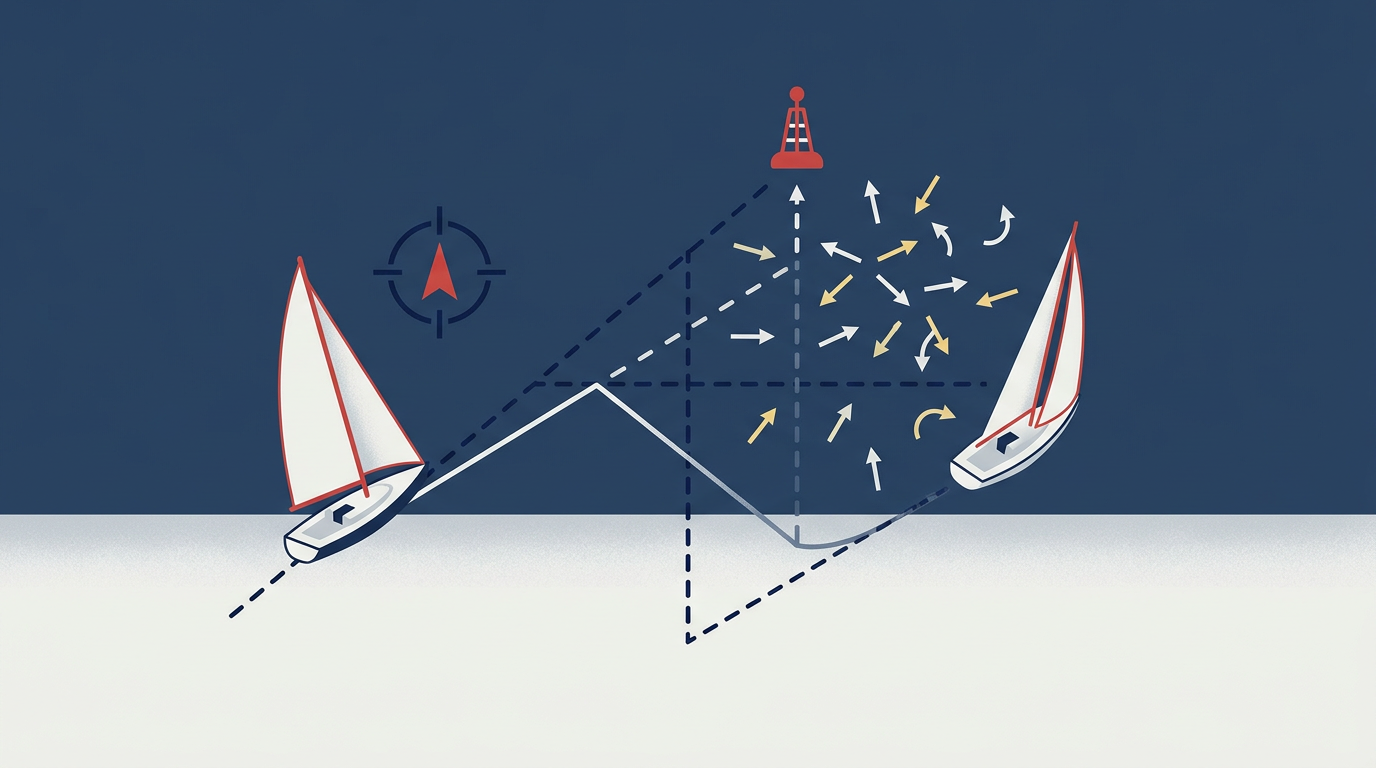
When we talk about the layline, we are talking about that imaginary line in the water where, if you tack onto it, you can sail directly to the windward mark without another maneuver. It sounds simple on paper, but in the heat of a race on Lake Mendota or Pewaukee Lake, it is one of the easiest ways to lose a podium position.
I see it in my classes all the time: sailors either tack too early (under-standing) and have to make two extra tacks right at the mark, or they tack too late (over-standing) and sail extra distance while their competitors slip underneath them. Today, I want to talk about how we can get better at judging these lines when the wind won't stay still.
Why We Over-stand on Inland Lakes
Inland Wisconsin sailing is characterized by 'puffy' and 'shifty' conditions. If you are on a starboard tack heading toward the port layline and you catch a brief lift, the mark suddenly looks much closer. If you tack right then, and the wind shifts back to its mean heading (a header), you will suddenly find yourself pointing below the mark.
This is why I always coach my students to 'wait for the header' before committing to a layline on a shifty lake. If you tack on a header, any subsequent shift back to the average wind direction will only lift you higher, giving you a safety margin. In match racing or tight fleet racing, over-standing by a boat length or two is often safer than being forced to tack in the 'bad air' of the fleet near the buoy.
A Real-World Example from Lake Michigan
Last summer, during a mid-week buoy race off the Milwaukee shoreline, I was coaching a crew on a J/105. We were approaching the windward mark on port tack. The wind was oscillating about 10 degrees every few minutes.
We had a competitor just to our leeward and ahead. They chose to tack early, right on the 'textbook' layline for the current wind. However, as we neared the mark, the wind headed them. They couldn't make the buoy and had to perform a 'double-tack' right in the zone. Under Rule 18.3 (Tacking in the Zone), they were in a very vulnerable position.
We stayed out another 15 seconds, deliberately over-standing by about three boat lengths. When we tacked, we had a 'fast' angle to the mark. Even though we sailed more distance, we kept our speed up and rounded three boat lengths ahead of the boat that tried to pin the layline perfectly. Speed is often more important than distance in those final 50 yards.
The Rule of Thumbs and Sight Lines
How do you actually 'see' the line? If you don't have high-end electronics, I suggest using your shoulders. On most boats, if you sit square on the high side and look directly over your shoulder, that line is roughly 90 degrees from your heading. If your boat tacks in 80 or 85 degrees (like a high-performance dinghy or a well-trimmed sportboat), looking just slightly forward of your shoulder line will show you where you will be heading after the tack.
Another tip: pick a landmark on the shore behind the mark. If the mark is lined up with a specific red barn or a water tower on the Wisconsin shoreline, and that landmark starts moving 'down' your side stay, you’ve crossed the layline.
Safety and Etiquette
Remember that once you are on the layline, especially the starboard one, you are the right-of-way boat under Rule 10 (On Opposite Tacks). However, don't use this as an excuse to hunt people. If you are on the starboard layline and a port-tack boat is approaching, be predictable.
Also, avoid 'pinching' to try and make a mark you've under-stood. When you pinch, you lose steerage way. On a crowded mark rounding in a heavy breeze, losing steerage is a safety hazard. It is always better to take the two quick tacks than to drift sideways into a buoy or another competitor.
Written by Dmitry Shteyn — Wisconsin sailor and educator. Find more sailing notes on the daily blog or read the longer guides.