Key takeaways
- Tack so your bow is slightly ahead of the opponent's mast to maximize the high-pressure interference.
- Ensure you complete your tack to a close-hauled course without forcing the windward boat to avoid you (Rule 13).
- Use the lee-bow to defend the favored side of the course by forcing opponents into a tack.
- Success depends on a fast, smooth tack that maintains boat speed and creates immediate pressure.
The Art of the Lee-Bow
One of the most satisfying maneuvers in sailboat racing isn't the start or the mark rounding—it's the perfectly executed lee-bow. If you’ve spent any time racing on the Great Lakes or some of our smaller inland waters in Wisconsin, you know that the difference between crossing ahead and being forced to tack away often comes down to just a few feet.
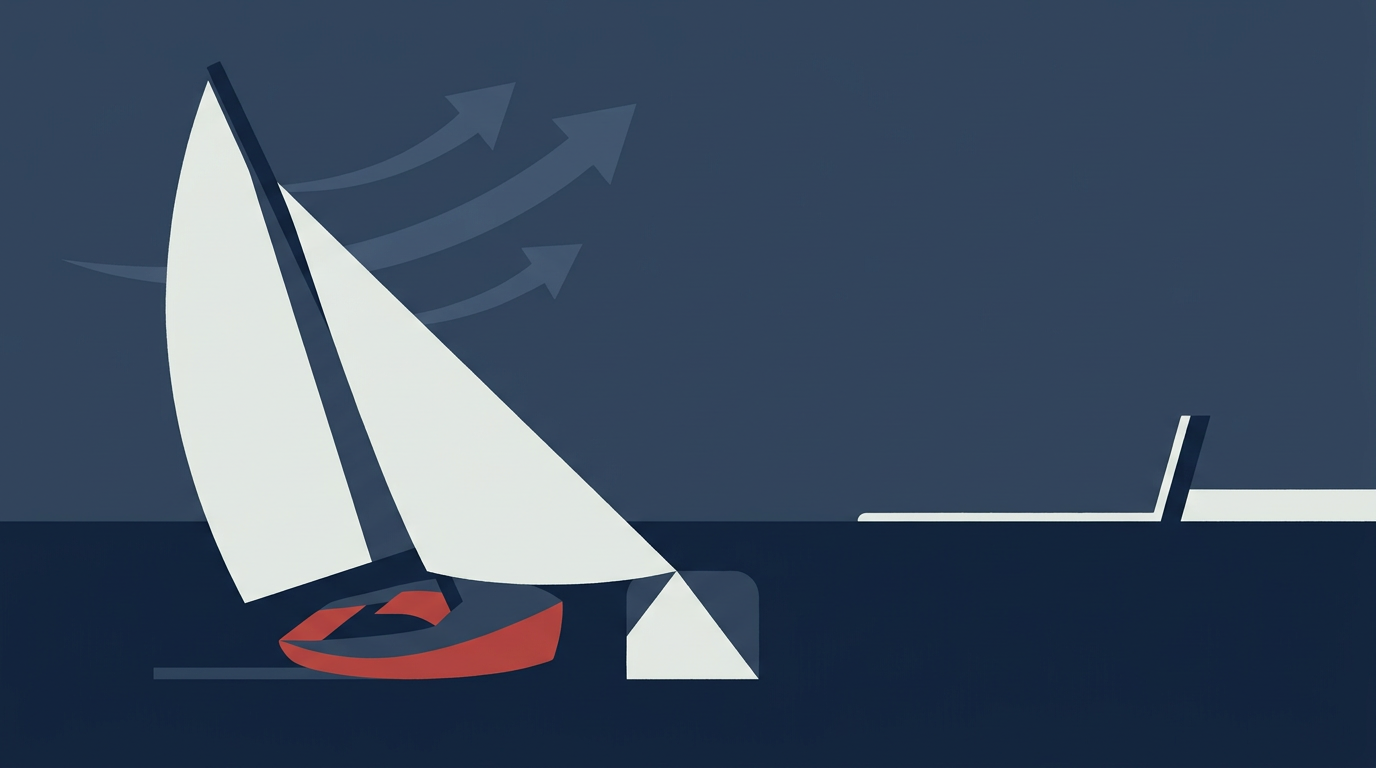
So, what exactly is the lee-bow effect? In simple terms, it happens when you tack just below and slightly ahead of a windward boat. By positioning your boat there, your sails create a high-pressure zone to windward and a low-pressure zone to leeward. This disturbed air header hits the windward boat, while your boat receives a slight lift or at least remains in clean air. The result? You slowly climb up toward their bow, forcing them to either pinch until they stall or tack away into less favorable air.
When to Pull the Trigger
The timing of a lee-bow is critical. If you tack too late, you’ll end up in the 'gas' (disturbed air) of the boat ahead, and you’ll quickly drop back. If you tack too early, the gap is too wide for your pressure wave to affect them, and they’ll simply over-hold and sail right over the top of you.
I remember a specific race on Lake Mendota during an E-Scow regatta. The wind was shifty, coming off the university buildings, and we were on a tight starboard tack approach to the weather mark. A rival boat was coming in on port. We had the right of way under Rule 10 (On Opposite Tacks), but instead of forcing them to duck us, we saw an opportunity. As they crossed our bow, we tacked into a leeward position.
Because we timed the tack so that our bow was just forward of their mast, they were immediately hit by our 'exhaust.' Within thirty seconds, they couldn't hold their lane. They were forced to tack onto port again, putting them behind us and away from the favored side of the course. It was a textbook execution that won us the leg.
Safety and the Racing Rules
While the lee-bow is a brilliant tactical move, you must stay mindful of the Racing Rules of Sailing. Rule 13 (While Tacking) is the big one here. Between the time you pass head-to-wind and the time you are on a close-hauled course, you must keep clear of other boats.
In a lee-bow situation, if the windward boat has to alter course to avoid hitting you before you’ve reached a close-hauled course, you have broken the rule. On Lake Michigan, where the swell can be heavy, I always tell my students to give an extra half-boat length of cushion. A rogue wave can kill your momentum halfway through a tack, making you a sitting duck for a protest or, worse, a collision.
Practicing the Positioning
To get this right, your crew work needs to be flawless. A slow tack is the enemy of a good lee-bow. You need a sharp turn, a quick trim of the jib to build speed, and then a steady hand on the tiller to 'guide' the boat into that high-pressure pocket.
Think of it as 'pinching with a purpose.' Once you are in that leeward position, you aren't just sailing your own race anymore; you are defending a lane. Keep your eyes on their jib. If you see their telltales fluttering or the boat starting to heel less than yours, you’ve got them. You are effectively pushing a wall of air up at them, making it impossible for them to point as high as you are.
Real World Application
When we run clinics out of Milwaukee, we often set up 'rabbit starts' to practice these close-quarters interactions. I see a lot of sailors hesitate. They worry about the proximity. But remember: sailing is a game of inches. Using your hull and your sail plan to influence the wind of your competitor is a completely legal and essential part of high-level racing strategy.
Next time you’re on the water and a boat is trying to cross you on port, don't just wave them through or shout 'starboard.' Think about whether a lee-bow tack will put you in a better position for the next shift. If the left side of the course is favored and you can force them to tack back to the right, you haven't just defended your position—you've dictated the rhythm of the entire race.
Written by Dmitry Shteyn — Wisconsin sailor and educator. Find more sailing notes on the daily blog or read the longer guides.