Key takeaways
- Head up in lulls to keep sails pressurized and maintain momentum.
- Jibe during gusts for better maneuverability and to stay in the pressure longer.
- Respect RRS Rule 11 when maneuvering for wind; windward boats must keep clear.
- Always scan the water behind you to anticipate upcoming shifts and pressure changes.
The Challenge of Inland Downwind Sailing
Sailing downwind on Lake Michigan is often a game of managing swell and steady gradients, but when we move inland to places like Lake Mendota in Madison or Lake Winnebago, the game changes entirely. The wind doesn't just flow; it pulses. As a sailing educator, I see many intermediate racers lose their podium positions not on the upwind beat, but during the transition between downwind gusts.
When you are sailing downwind in a shifting, puffy environment, the biggest mistake is staying static. You cannot simply set your trim and wait for the leeward mark. You have to actively hunt the pressure and manage your apparent wind constanty.
The Apparent Wind Trap
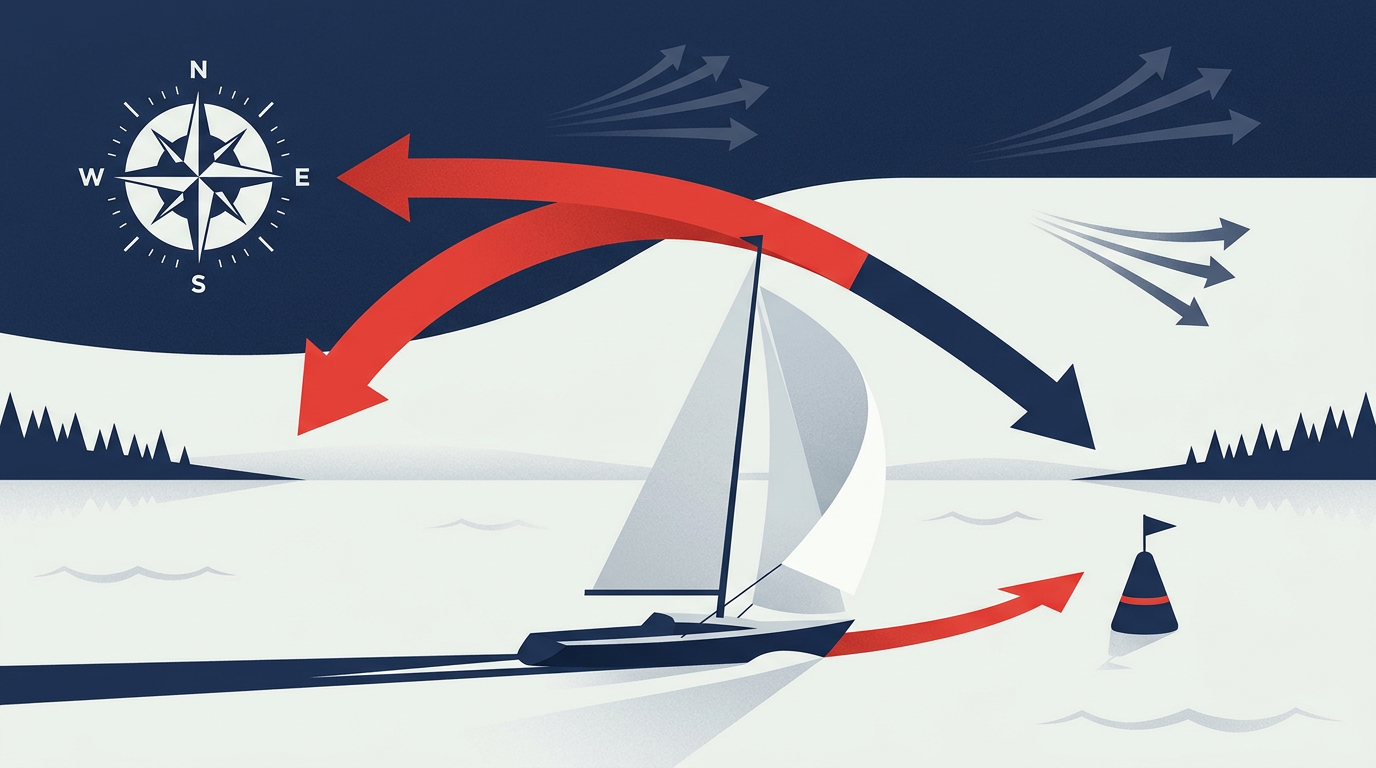
On an inland lake, a gust hits you from behind and slightly to one side. Your first instinct is to head down (away from the wind) to stay in the breeze longer. This is correct, but the danger lies in what happens when that gust fades. As the wind speed drops, your boat speed stays high for a few moments due to momentum. This causes your apparent wind to swing wildly forward.
If you don't react by heading up (closer to the wind) immediately, your sails will stall, your pressure will vanish, and you'll find yourself 'parked' while the rest of the fleet sails around you. I often tell my students: 'Drive to the pressure, but steer for the speed.'
A Lesson from Lake Pewaukee
I remember a regatta on Lake Pewaukee a few seasons ago. We were in C-Scows, which are notorious for being sensitive to weight placement and trim. We were leading the pack toward the leeward gate when a massive header hit us—a shift coming from the right that also brought a 5-knot drop in wind speed.
Most of the fleet stayed on their original course, trying to maintain their line to the mark. We immediately hardened up about 15 degrees. By heading up, we kept the flow over the sails active despite the dying breeze. We sailed a longer distance, but we kept the boat moving at 5 knots while our competitors dropped to 2 knots. By the time the next puff reached us, we were already a hundred yards ahead because we never let the boat 'die' in the water.
Using the Rules to Protect Your Lane
When fighting for these lanes in a crowded inland field, you must be hyper-aware of your rights under the Racing Rules of Sailing (RRS). When you are heading up to keep your speed in a lull, you are often the windward boat if you are slightly ahead of a competitor.
Remember Rule 11: 'When boats are on the same tack and overlapped, a windward boat shall keep clear of a leeward boat.' If you are heading up to find breeze, make sure you aren't infringing on a leeward boat's right to sail their course. Conversely, if you are the leeward boat and a lull hits, you have the right to luff slightly to maintain your speed, provided you give the windward boat room to keep clear under Rule 16.1.
Tactical Jibing in Gusts
Inland sailing is rarely about sailing the shortest distance; it’s about sailing the fastest time. This often means jibing more frequently than you would on the Great Lakes.
- Jibe in the Puffs: It is always easier to turn the boat when you have maximum rudder authority and pressure in the sails.
- Look Behind You: The next gust is always visible on the water as a dark patch. Don't wait for it to hit you; jibe so that you are positioned to lead that puff down the course.
- Clear Air is King: On a crowded inland lake, the 'shadows' cast by other sails are massive. If you feel your pressure dropping and see a wall of white dacron behind you, jibe away immediately to find a clear lane.
Safety and Control
Downwind sailing in gusty conditions can lead to the dreaded 'death roll' or an accidental jibe. Always keep your mainsheet trimmer active. When the boat starts to oscillate, a small reef on the mainsheet can stabilize the rig. Keep your weight centered and low, and never take your eyes off the tell-tales or the water surface behind you. Staying proactive is the best way to stay upright and fast.
Written by Dmitry Shteyn — Wisconsin sailor and educator. Find more sailing notes on the daily blog or read the longer guides.