Key takeaways
- Always check for crew safety and uncleat all sheets before attempting to right the boat.
- Prevent turtling by getting weight on the centerboard immediately to counteract the mast's weight.
- Orient the boat so the mast points downwind; this allows the wind to help lift the sails during recovery.
- Use the 'scoop' method in crewed boats to ensure one person is immediately in control of the tiller.
The Inevitable Dip
If you aren't capsizing every once in a while, you aren't hiking hard enough. Whether you're on a Laser, a 420, or an M16 scow, going over is simply a part of the sport. In my years coaching on Mendota and Michigan, I’ve seen sailors treat a capsize like a disaster. It isn’t. It’s just a maneuver you haven't finished yet. The goal is to get the boat back under you quickly, safely, and without outside assistance.
Immediate Priorities: The Safety Check
The moment you hit the water, your first job isn't the boat—it's the people. Check on your crew. In a two-person boat, make sure everyone has surfaced and no one is tangled in the sheets or trapped under the mainsail.
Once everyone is accounted for, stay with the boat. A dinghy is a massive flotation device; even if it's full of water, it’s easier for a safety boat to spot a hull than a bobbing head. Under World Sailing's Racing Rules of Sailing, Rule 1.1 emphasizes that a boat or competitor shall give all possible help to any person or vessel in danger. If you see someone turtled and struggling, the race becomes secondary to their safety.
Preventing the Turtle
A 'turtle' is when the boat flips completely upside down with the mast pointing at the lake bed. This is much harder to recover from, especially in the shallow areas of Lake Winnebago where your mast can get stuck in the mud.
To prevent this, get to the centerboard (or daggerboard) immediately. By putting your weight on the board early, you counteract the gravity pulling the mast down. If you're on a boat like a 420, one person should climb onto the centerboard while the other holds the forestay or the bow to keep the boat pointed into the wind.
The Righting Process
Before you heave the boat up, you must check your sheets. This is the mistake I see most often during regattas in Madison. If the mainsheet or jib sheet is cleated, the sails will fill with water as the boat rises, or worse, the boat will sail away from you the moment it stands up. Reach into the cockpit and ensure all lines are blown (uncleated).
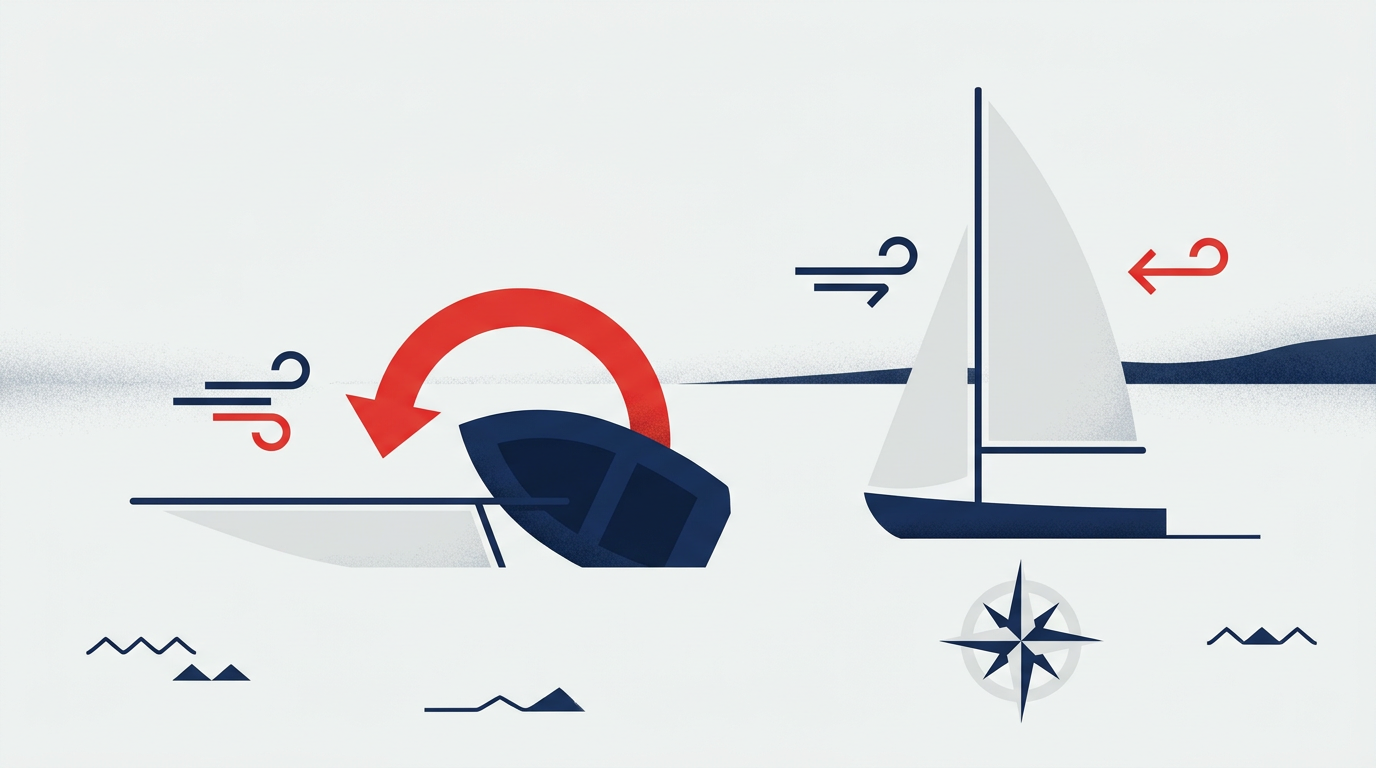
- Position the Boat: Try to get the bow pointed roughly into the wind. If the wind gets under the sail as you right it, the boat will help you lift the mast. If the wind is hitting the top of the sail, it will just pin you down.
- Leverage the Board: Stand on the centerboard close to the hull and lean back. Hold onto the gunwale or a righting line. Use your body weight, not your arm strength.
- The Scoop Method: In a two-person boat, the 'scoop' is the most efficient way to get moving. One person stays in the cockpit as the boat comes up. As the boat rights, they are 'scooped' inside. They can then immediately grab the tiller and help the other person over the transom.
A Real-World Lesson on Lake Michigan
I remember a blustery spring day out of Milwaukee where a student of mine went over in a Laser. The waves were about three feet and choppy. He did everything right—cleared the sheets and got on the board—but he forgot to check his orientation to the wind. Because the mast was pointing upwind, the wind caught the underside of the sail as the boat came up, flipping the boat right over onto him on the other side. We call this a 'dry capsize' when you do it on purpose, but in those conditions, it just leads to exhaustion. Always ensure the mast is pointing downwind before you start your pull.
Getting Back to Racing
Once the boat is upright, your next challenge is the water inside. Most modern dinghies have self-bailers or open transoms. You need forward motion for these to work. Get the boat moving on a reach, open the bailers, and let physics do the work.
Remember, per Rule 41, you cannot receive outside help to right your boat if you want to stay in the race. If a coach boat touches your hull or helps you pull it up, you've technically retired from that race. Practice your recovery until it’s muscle memory; it’s the only way to turn a capsize from a race-ender into a minor hiccup.
Written by Dmitry Shteyn — Wisconsin sailor and educator. Find more sailing notes on the daily blog or read the longer guides.